



Diversification opportunities on the agenda for companies at major energy supply chain conference

George Rafferty, Chief Executive of NOF Energy who will open the conference in Glasgow next month More than 300 energy sector professionals will attend a major conference and exhibition in February to hear about diversification opportunities and significant developments within the industry’s supply chain. The Scotland Supply Chain Conference and Exhibition, organised by UK energy sector business development organisation NOF Energy, takes place on 25th and 26th February at the Crowne Plaza Hotel, Glasgow. Now in its second year, the event, which is supported byScottish Enterprise, provides delegates the chance to hear from some of the energy industry’s key players from across the oil & gas, offshore renewables and nuclear sectors. Industry update speakers include Matt Abraham, Supply Chain & HSE Director from Oil & Gas UK, Sylvia Buchan, Supply Chain Manager at Oil & Gas Authority, Neil Douglas, Director at BVG Associates, discussing offshore wind, and Glen Little, Industrial Advisor from the Nuclear Industry Association. A major focus of the conference will be diversification and the opportunities for supply chain businesses who can transfer existing skills, products and services into complementary sectors. Among the speakers on this subject will be Charlotte Taylor, Energy Specialist from Scottish Enterprise who will talk about using oil & gas expertise to win business in other sectors. In addition, Stephen Thompson, Business Development Director, Renewables at Global Energy Group, will discuss how the company transitioned from oil & gas into offshore wind, alongside Stuart Olden, Business Development Manager, from Williams Advanced Engineering who will tell delegates about his company’s journey from Formula 1 motor racing to offshore wind. Five key sessions take place in the afternoon highlighting supply chain opportunities with companies in oil & gas, nuclear and offshore wind including presentations from Dounreay, Hurricane Energy,Inch Cape Wind Farm – Red Rock Power Limited, Shell and SSE Renewables. Alongside the conference, which is sponsored by Allied International, the Scotland Supply Chain event will feature an exhibition of products and services from some of the UK’s leading energy sector suppliers and will also be a hub for networking. The evening prior to the conference and exhibition will also provide an important networking opportunity with NOF Energy hosting a reception on Monday 25th in the exhibition area. George Rafferty, Chief Executive of NOF Energy, said: “There is a wealth of skilled and experienced supply chain companies that have the potential to grow their operations through diversification. Energy presents real opportunities for both companies already operating in the industry and for those with transferable products and services from other markets that can be applied to the sector. “The Scotland Supply Chain Conference and Exhibition is the ideal platform for businesses keen to enter or expand their presence in the energy sector. We have brought together key people from across the industry who will provide both a valuable insight into developments in the sector, but also how they are expanding their own supply chains. This, alongside the networking opportunities with hundreds of delegates and exhibitors, ensures attendees will see the benefit of exploring diversification.” To secure a delegate place at the Scotland Supply Chain Conference or to find out more about exhibiting and sponsorship, visit http://www.nofenergy.co.uk or contact Philippa psmith@nofenergy.co.uk
Medusa LED Streetlight At Forefront Of Design & Technology
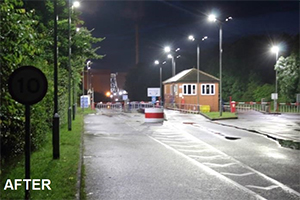
Medusa is the latest generation of LED streetlight from Ecolighting. Robust and weatherproof to IP65, the Medusa luminaire is easy to maintain, lightweight and has a stylish aluminium body. Designed with a Philips advanced xitanium driver and Samsung or Cree LEDs, a NEMA five-pin plug comes as standard for telematics such as TELENSA or similar open protocol. By using top quality LEDs in Medusa, Ecolighting ensures high thermal conductivity, minimal light decay, pure light, very stable performance and a 50,000-hour lifespan. As a result, Ecolighting offers a 10-year conditional guarantee with optional photocell control and a pre-programmed dimming cycle for smaller projects. The Medusa comes in three sizes and 10 different LED power outputs from 14W to 250W. The system uses LEDs producing 115 lumens per watt and a colour temperature of 5000K, top quality modular drivers and has surge protection to 10KV. www.ecolightinguk.com Tel: 01455 552511 enquiries@ecolightinguk.com
Lone Working Needs Sensible Risk Assessment

According to online statistics website, Statista, there were 265,000 electricians working in the UK in 2017 and whilst the numbers weren’t so readily available, it would not be unreasonable to presume that many of them carry out what is referred to as “lone working” as a significant part of their daily work. This includes those employed or self-employed. Since 2015, certain self-employed persons have been exempted from health and safety law. This is strictly limited to those whose work activities pose no potential risk of harm to others. Clearly work on electrical systems cannot be described as non-hazardous. Lone working isn’t against the law, but it is essential that you take sensible precautions if you are going to be working alone. When deciding if it is appropriate for employees to work alone, employers need to consider if the working environment presents any significant hazard and if access presents additional risks. Before carrying out work at someone else’s premises it is important to understand the risks inherent with the work and the location. If they are commercial premises, there must be a record of any asbestos containing materials on the premises and workers should acquaint themselves with this before starting work. The Control of Asbestos Regulations also require electricians to have attended formal asbestos awareness training. It is important that when you chose a training provider, that they be able to demonstrate competence. AT THSP we currently have seven trainers, all approved by UKATA to deliver this training and with a passion for ensuring that operatives are no longer exposed to the life-threatening risks associated with disturbing asbestos. Whilst an employer may have drawn up a generic risk assessment for the tasks being undertaken, it is essential that the engineer has been trained to spot any additional hazards and knows what steps to take. Some hazards can be easily addressed and controlled, however others will need to be referred to a line manager or other competent person. The Risk Assessment Builder developed by THSP is an intuitive and interactive programme allowing employers to produce site specific risk assessments in a fraction of the time it would take from scratch. Furthermore, due to the extensive data supporting the tool, users can generate over 10 million different outcomes. These assessments can be accessed online by employees along with an online briefing to demonstrate that they have received this vital information. Current advice from HSE is that there are some high-risk activities where at least one other person may need to be present. Examples include: working in a confined space; working at or near exposed live electricity conductors; or health and social care work dealing with unpredictable client behaviour and situations. Risk assessments and the need to make sure they are suitable and sufficient remains a thorny issue for many employers. Some companies rely heavily on libraries of generic assessments, drawn together over the years, or downloaded from remote websites or even “borrowed” from other employers. This can give “the illusion of control” and where they are clearly irrelevant, encourage employees to disregard them. How much supervision is needed should be determined in your risk assessment, the higher the risk, the greater the level of supervision required. It should not be left to the individual lone worker to decide if they need help. Your risk assessment should identify the possibility of an emergency arising and set out clear procedures to be followed. A first aid kit may be necessary as well as formal training. Lastly you will need to put in place monitoring and communication arrangements. This could be: Periodic visits by supervisors; Regular contact by phones, radios or email; manually operated or automatic warning devices; and A robust system ensuring lone workers have returned home safely. Whatever you do, it is important to ensure that not only do lone workers have the skills, experience, knowledge and training to enable them to work safely, but that those managing them understand their responsibilities.
The importance of apprenticeships in the construction industry

Apprenticeships are more crucial than ever before as construction experiences a shortage of skilled workers, with employers finding recruitment tough. The construction industry is experiencing a huge shortage of skilled workers, with 87% of employers finding it difficult to recruit the right type of employee that they need, according to City & Guilds. According to Construction News, official figures show that 12.6% of UK construction workers come from overseas, with 5.7% originating from the EU. This rises to a staggering 60% in London. Furthermore, 30% of British-born construction workers are now over the age of 50, meaning businesses will feel the pinch of those departing over the coming years through retirement when Brexit comes into play. However, some experts believe that apprentices could be the key. National Apprenticeship Week last March saw an influx of publicity circulating, which encouraged employers to think about the future of their workforces — could apprentices fill the employee shortage? Niftylift, retailers of work platforms, investigates apprenticeships further. Within the top 5 sectors for apprenticeship starts are engineering & manufacturing, planning and construction. In the 2016/17 academic year, the engineering & manufacturing sector witnessed 74,000 starts, while the construction sector had 21,000. Leading UK housebuilder Redrow released its second annual research report which revealed that, thanks to a positive shift in attitudes and the perception of construction, the apprenticeship pathway has improved – with a 14% increase in young people considering a career in the sector. Speaking on the report, Karen Jones, Group HR Director at Redrow, said: “This year’s results illustrate that apprenticeships and careers in construction are being viewed in a more positive light. “Apprenticeships are a way of futureproofing the UK workforce, particularly in sectors where there is a skills shortage, such as construction, so it is pleasing to see that progress is being made.” Success is set to continue, thanks to the new apprenticeship levy that was introduced recently to help fund apprenticeship programmes. Whilst some employers have snubbed the new levy as just being ‘another tax’, both large and small employers can benefit from the fund, meaning that 90% of apprenticeship training costs are funded by the government. Furthermore, employers within the construction sector can use up to 10% of the funding to train employees across the full supply chain — something not to be snubbed with the current shortage of skilled workers. A whopping 86% of employers state that apprenticeships are helping them develop skills relevant to their business, with 78% saying that apprenticeships also help boost productivity, according to UK Construction Media. Furthermore, Chris Wood, CEO of Develop Training, is confident that apprenticeship programmes are working: “Working with some of the UK’s largest utility firms, our success rates have been very high. We and our customers have no doubt that, managed well, apprenticeships do work.” He added: “New initiatives such as Trailblazer Apprenticeships and the Apprenticeship Levy have raised awareness across the UK. Even so, and despite huge skills shortages, many employers are still only scratching the surface of what they could be doing to use apprenticeships to attract new people to join the industry and improve the skills of existing employees.” In the future, fulfilling the demand in the construction industry could purely hinge on the success of the apprenticeship schemes being run up and down the country. Downing Street has committed itself to creating three million new apprenticeships by 2020. The construction industry could be on the receiving end of a large chunk of those programmes, which will be an opportunity to deliver a new generation of highly skilled workers — something that the industry is experiencing a lack of right now. In fact, the Director of the National Apprentice Service, Sue Husband, predicts that 2018 will be crucial for programmes. As more opportunities become available, now could be the time to cut yourself a slice of the apprenticeship programme success — and secure your future workforce now. Sources: ukconstructionmedia.co.uk constructionnews.co.uk cinmagazine.co.uk ukconstructionmedia.co.uk constructionnews.co.uk
Final Salary Pension Transfer: where do you stand?

Due to the pension changes, introduced in April 2015, there has been an increased interest in final salary pensions transfers (or defined benefit transfers). It is now possible for many people to transfer out of a final salary pensions scheme into a defined contribution scheme, to take advantage of the new pension rules which allow full access to a pension fund. Here Mark Stewart, director at Sheards Wealth Management, offers his Top 10 Tips for considering Final Salary Pension Transfer… 1. Consider all your options. Due to the pension changes introduced in April 2015, there has been an increased interest in final salary pension transfers. But there are risks involved so it’s important to consider every option available to you. 2. Be aware of scam schemes. Those looking to cash in on final salary pensions are being put at risk of scams by advisers who aren’t doing proper transfer checks. Make sure you speak to your adviser and check they have a robust due diligence process. 3. Understand the investment risk. The saying that “past performance is no guide to future performance” still rings true. A final salary pensions scheme mitigates many of the risks of retirement for you but that risk becomes yours if you transfer out. 4. Consider what you’re giving up. A good question to ask yourself is “why do I wish to give up an index-linked income stream that I cannot outlive and that goes to my spouse at 50% should I die?” 5. What is your marital position? Most schemes will normally pay 50% of your pension to the spouse on death, for single or divorced members this has no value, however the transfer value includes the cost of providing spouses benefit and can therefore be realised to the member on transfer. 6. Consider the state of your health. If your life expectancy is reduced then the opportunity to spend more income in the early years via flexi-access might seem more attractive which can be achieved through the inflexibility of a defined benefits scheme. 7. What is the value of your assets, other income and other pensions? If you aren’t dependent on the final salary pension as your only income in retirement, then it might be that a transfer is more appropriate. 8. What is your current expenditure? An increasing retirement income from a final salary scheme might be more appropriate for those who have a higher expenditure than someone who has more modest outgoings. 9. What is your current tax position? Another benefit of final salary transfer is that it gives you the ability to take income as and when required which might allow you to mitigate income tax. 10. Ensure you get sound financial advice. A transfer offers you complete flexibility and control over your pension but as outlined there are a number of risks and other factors as to why it wouldn’t be suitable, so ensure that you seek an experienced specialist for advice. For more information on pensions visit www.sheardswealthmanagement.co.uk About Sheards Sheards Wealth Management Limited was formed in 2008 in response to increasing requests from clients of Sheards Accountancy for advice on financial advice type matters such as investment and pension issues. Sheards Wealth is headed up by Mark Stewart who has over 25 years experience in the financial services sector before joining forces with Sheards Accountancy. Sheards Wealth Management now employ 7 members of staff at its headquarters in Huddersfield but serve clients throughout Yorkshire and the North East. Twitter: @SheardsWealth
Rogue trader jailed after investigation

A man has been jailed for carrying out dangerous work while posing as a registered electrician. John Draco, 35, of Rowan Place, Newton Aycliffe, pleaded guilty to fraud and consumer protection related offences after falsely claiming to be a qualified electrician. He advertised his services on Yell.com as accredited by ELECSA and Trustmark-despite not having either accreditation. He also claimed to be NICEIC registered. He was jailed for 13 months following a trial at Durham Crown Court in January. The court heard how Draco had offered to complete a full rewire of a property for £3,000, but had left it in a highly dangerous state. When his shoddy work was challenged by the homeowner, he abandoned the job and kept the full sum. The homeowner got in touch with Hartlepool Trading Standards who took on the case with help from ELECSA. Such was the poor standard of the installation an investigation by an electrical engineer ordered it not to be used as it posed a serious risk of fire and electrocution. Work to rectify the problems left by Draco ran into thousands of pounds. Draco, who traded under the name J and A Electrical Solutions ended up paying the victim back £3,820. Ian Harrison, Hartlepool Borough Council’s Trading Standards and Licensing Manager, said: “This successful prosecution sends out a strong message that the courts will not tolerate rogue traders conning people out of their hard-earned cash. Kevan Parker, Interim Managing Director of Certsure, which operates the ELECSA and NICEIC brands, added: “We take a dim view of those who pretend to be registered electricians when they are not. “We will work with the appropriate authorities to protect those contractors who are legitimately registered with us and have the quality of their work assessed on a regular basis. “Anyone thinking about using our logo fraudulently will be caught and dealt with appropriately by the courts.”
New technology and red tape will drive change in learning and training in 2019

That’s the verdict in a new report from utilities training specialist Develop Training Ltd (DTL). With the utilities sector facing rapid and fundamental change, the white paper highlights how new regulatory and technological developments will present businesses in the sector with a raft of challenges. The report entitled ‘Utilities sector: Facing regulatory and technological change’ is available to download at https://tinyurl.com/DTL-RegandTechReport. The authors, whose customers include household names in the utility and construction sectors, point out that these industries face growing challenges in mission critical areas. Those challenges include improving efficiency, reducing costs, increasing resilience and meeting customers’ changing expectations. Yet, the report notes, it is unclear how many of these tests will unfold, or how best to approach them. John Kerr, DTL’s Operations Director, said: “To be successful in this business environment, organisations must be innovative, responsive and customer-focused. That takes a skilled, flexible and motivated workforce, and investing in the right kind of training now so that businesses are prepared is critically important.” He said as the challenges facing the sector were constantly developing, organisations would need to keep reassessing and revitalising their learning and development approach to ensure that the right skills were in place. The whitepaper discusses the challenges facing organisations in the utilities sector in depth, and forecasts how these will affect learning and development strategies in 2019 and beyond. It concludes that adapting learning and development processes is a vital part of strategic planning, as utility companies prepare for an uncertain future. www.developtraining.co.uk
Celebrating Young Talent in the Construction Industry

Generation 4 Change (G4C), part of Constructing Excellence – provides a platform to grow and learn through creating development and networking opportunities with a broad spectrum of construction industry professionals. Generation 4 Change is passionate about showcasing emerging talent and the 2019 Midlands G4C Awards celebrate the achievements of young industry professionals and provide an exclusive opportunity to celebrate outstanding examples of excellence and best practice within the construction sector. Enter Today G4C aims to be the organisation that is the driving force for industry change, through the development of the future industry leaders. To gain recognition and industry acclaim – enter the Midlands G4C Awards to kickstart your career in construction. These awards recognise young achievers under 36 years of age and are not restricted to those engaged with the Generation for Change movement within Constructing Excellence. There are six categories available to enter: Apprentice of the Year Judges are looking for trade or technical apprentices who are currently undertaking or have completed training since January 2018. Award submissions should demonstrate how the candidate has created a positive impact on the industry, organisation or college, through a commitment to personal development. Student of the Year For candiates who stand out from the crowd, the judges are looking for students who demonstrate high skill levels and motivation while aiming to become one of the future leaders of the industry. This award is open to any Higher Education or Further Education students within the construction and built environment sectors, at any level. Young Trainee of the Year Training can include short courses, industry recognised training and personal development. Judges are looking for candidates who are currently undertaking or have completed training since January 2018. Applicants should demonstrate achievements throughout their career and how they have developed communication, team and leadership skills. Young Professional of the Year Judges are looking for candidates who have completed professional studies or professional development within the construction and the built environment sector since January 2018. Applicants should demonstrate how they have excelled, by striving to make great contributions to the industry, while demonstrating exemplary performance in their field of expertise – standing out from their peers. Mentor of the Year Judges are looking for individuals of any age, who have a good knowledge of current topics in the industry and have shown a commitment to developing future leaders by investing time to nurture and mentor, while offering support and guidance. Commitment to Training & Development This award is open to organisations with any number of employees who have demonstrated and sustained a commitment to training and development. Judges will be looking for companies who invest time and resources into developing the next generation and set clear targets providing staff with regular appraisals and feedback. For more information on each Midlands G4C Award category visit: https://www.g4cawards.co.uk/enter-now/categories
New Range of LED Fire Rated Downlights Launched at Elex Coventry

GreenBrook are delighted to present their new range of LED Fire Rated Downlights – The Vela Range – which consists of five different options. The Vela Compact range – this is a super low profile fitting that you are able to place in shallow ceiling voids and place the insulation directly over the fitting. This fitting has been independently thermally tested by the LIA and is a contractor favourite. Next, we have launched the Vela Compact PRO – again a shallow fitting but with a neatly styled prismatic bezel and offering a quick connect driver with loop-in and loop-out connections. Next in the range is the V7 – a flicker free, highly efficient fitting offering fixed, tilt and anti-glare options. This model too offers a quick connect driver for improved installer satisfaction. Next we offer the sleek, modern Vela Advance – a 9W super stylish fitting that has been used in many blue-chip projects – which again boasts a fixed, tilt and anti-glare option and finally we are launching the new Vela Switch – a colour changing downlight that can be switched from 3,000k to 4,000k. All the Vela range are tested to ensure they are suitably fire rated for use in 30, 60 & 90 minute ceilings and all conform to EN 60598 and to Building Regulations Part B, C, E & L. For further information please see our new brochure. www.greenbrook.co.uk
