



Snickers Workwear For Summer

Snickers Workwear = Comfort = Wellbeing and Improved Performance. Everyone wants to be cool, and comfortable at work this summer – and to do their bit for saving the planet. That’s why Snickers Workwear has integrated improved 37.5® fabric technology and ‘Verifiable Sustainability’ into its T- and Polo-shirts. The new AllroundWork styles are made from highly functional waffle- structured 37.5® fabric for optimal ventilation, cooling and moisture transport to keep you feeling fresh for longer. And, with the aim of being at the forefront of sustainability in Workwear, the new lightweight Polo and T-shirts are made of 100% recycled polyester with a bio-based, anti-odour finish with a smooth texture and efficient moisture transport for great working comfort. They’ve all got street-smart body-mapping designs for an amazing fit, outstanding functionality and long-lasting comfort – all day, every day. Getting information on the Snickers’ Summer Workwear range is easy. You can call the Hultafors Group Helpline on 01484 854788. You can check out the website and download a digital catalogue at www.snickersworkwear.co.uk or email sales@hultaforsgroup.co.uk
Lighting industry broadly welcomes Ecodesign legislation

The lighting industry has broadly welcomed new legislation which seeks to bring back the replaceable light source. However, many had concerns over how the market for replacement components would work in practice. Over 150 attendees from across the industry tuned in to listen to the second Recolight circular economy webinar. A panel of six discussed the impact of forthcoming EU and UK Ecodesign legislation, under which lighting manufacturers must incorporate removeable light sources and control gear in their products. This was a timely debate with the regulations due to be implemented in September 2021. On the panel were Ray Molony of the Build Back Better awards who also chaired the event, Peter Hunt of the LIA, Dee Denteneer of Zhaga Consortium, for end users perspective, Geoff Coffin of Store Maintenance Limited, representing lighting manufacturers Phil Muir of Designplan Lighting, and Sophie Parry of Zumtobel Group. The impact of Ecodesign regulations on lighting Introducing the event Ray Molony asked the panel “How will this work in practice? Some fear that the replaceability requirements will create a technical, interoperability and warranty minefield.” The legislation requires manufacturers to ensure that the light sources and control gear can be replaced with the use of commonly available tools. Manufacturers will be obligated to provide technical information on how the components can changed. In some cases, the light sources and gear can be changed by the end-user; in others, by a ‘qualified person’. Geoff Coffin said he would like to see replacement components that are easy to procure, install, and competitively priced. “We then need to educate users and prove that this can be done to the benefit of the environment and their pockets.” Phil Muir commented that “Maintainability has to be designed into new luminaires at the initial design stage.” Sophie Parry proposed that luminaire types should be segregated by market sector to prepare relevant guidance on technical, interoperability, warranty, on site repair or re-purposing issues. This proposal was picked up by Peter Hunt, who indicated that the LIA would consider options for guidance on this basis. Dee Denteneer hoped that eco-design rules would bring about greater awareness with end users/contractors about the need for re-use and recyclability. He added that interoperability is fundamental to Zhaga consortium members and many end users. In conclusion the panel agreed that: • The Ecodesign regulations may move more lighting to a service model • This is the first step towards circular economy legislation – there will be more. • The industry would benefit from guidelines that identify the best practice approach. • Manufactures need be able to demonstrate extended life cycles, and the benefits this brings. This was the second in the 2021 Recolight webinar series focusing on Lighting and the Circular Economy. To view the replay and register for future events, please visit the Recolight Event Page.
Schneider Electric Updates EcoStruxure Specifier Tool With New UPS

Schneider Electric, the leader in digital transformation of energy management and automation, has today announced updates to its EcoStruxure Specifier Tool, adding single and three-phase uninterruptible power supply (UPS) technologies that enable partners, including electrical specifiers, contractors, IT solutions providers and VARs, to quickly specify projects and complete tenders. The free online tool now includes the recently announced Schneider Electric Easy-UPS™ range, Galaxy™ family, and Smart-UPS™ with Lithium-ion batteries, enabling consultants and engineers to specify UPS requirements from 1-1500kVA rating with advanced and innovative features such as efficiency, modularity, battery type, architecture and redundancy. Building on the developments announced in 2020, which saw new mechanical specifications added to the software, the EcoStruxure Specifier Tool makes the process of generating, editing and completing tenders easier; helping users to quickly design and specify mission-critical power systems that drive uptime and business continuity. The new update also provides partners with access to pre-tested electrical reference designs, enabling them to identify ways to increase project revenue, such as through the integration of Electric Vehicle (EV) charging stations in Smart Buildings and data centres, and by bidding on larger-scale electrical projects. “The new updates to the EcoStruxure Specifier Tool enable rapid modernisation, ease of use and streamlining of tender proposals for UPS applications,” said Andrew Wakeley, Customer Channel Marketing Manager for Schneider Electric UK&I. “With greater enablement and access to a diverse range of power technologies, our partners can quickly design, specify and bid on large-scale electrical projects, supporting their growth in collaboration with Schneider Electric’s products and services.” Simplifying mission-critical design Accessed within the Schneider Electric partner portal, the EcoStruxure Specifier Tool allows consultants to create customised pages for end-user projects, while its intelligent learning capabilities analyse tender information to gain a better understanding of the customer application. The analysis suggests products, solutions and reference designs, which will ensure uptime and reliability across customer sites. Further, by utilising the tool, partners are able to diversify existing skill sets and train their engineering teams to bridge the skills gap; specifying resilient backup power systems that combine performance with efficiency. “With greater focus on Net Zero and sustainability initiatives, partners need access to the latest technologies and a means to both guide and educate their customers,” said Marc Garner, Vice President, Secure Power Division, Schneider Electric UK&I. “The EcoStruxure Specifier Tool is designed to help electrical and IT professionals work in collaboration with end-users, providing guidance on how to balance mission-critical reliability with electrical energy efficiency, for a long-term, sustainable outcome.” For more information on Schneider Electric’s EcoStruxure Specifier Tool, please visit the website.
Recolight sets ambitious goal to be carbon neutral by 2030

Recolight, the UK’s leading lighting WEEE compliance scheme, has set a target to be net zero carbon by 2030. The target, agreed by the Recolight board in January, will cover all Recolight’s operations. Commenting on the news, Recolight CEO Nigel Harvey said “As a recycling compliance scheme, Recolight is already committed to limiting the environmental impact of the services we provide. But now we want to go much further. Although recycling activities are undoubtedly beneficial for the environment, they still come with a carbon cost. We want to change that.” A recycling service can produce significant carbon benefits. For example when aluminium is recycled, that avoids the need to extract the metal from bauxite, a process that is very energy intensive. However, a collection and recycling service also incurs material carbon costs, particularly when waste is transported from collection point to recycler. Harvey added “Dealing with the transport carbon will be particularly challenging. In our next tender for transport services and treatment services, due at the end of this year, 25% of the evaluation points will be awarded for robust plans and actions towards achieving net zero.” To provide an incentive and roadmap to help the industry work towards net zero carbon Recolight plans to make up to £50,000 available, on a competitive basis. This is intended to help companies establish zero carbon or low carbon collection, or recycling, of waste lamps. Harvey concluded “This is not going to be easy. But we are determined to make it happen. What is more, wherever possible, we will avoid carbon offsets and similar creative carbon accounting. We need a root and branch change of the way we operate. That will probably only be possible if others in the WEEE and recycling industries also play their parts.”
Mechanical Ventilation Systems: Where Not to Cut Costs
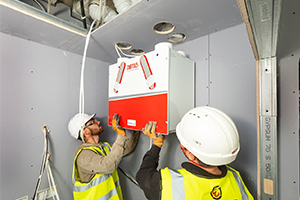
By Paul Williams, Domus Ventilation Product Manager Prior to a revision of Building Regulations in 2010, ventilation was not high on the list of priorities in the house building sector. A fan in the bathroom and cooker hood in the kitchen, plus ventilation blocks in the walls, were the default setting. Then, gradually, ventilation began to make it on to the agenda, largely driven by the now defunct Code for Sustainable Homes. The Code required homes to be better insulated and more air tight to stop the heat leaking out of them and wasting energy. Of course, the more air tight a property is made, the greater the requirement for ventilation to ensure good quality indoor air. At the time the Code was in use, the focus was on preventing / removing condensation. More recently fears over pollution and over-heating have taken over as the imminent threat to the health of residents. Changes to Building Regulations Part F announced this year acknowledges these issues and the important role ventilation has to play in maintaining good indoor air quality. It lays out more stringent ventilation requirements for new builds, plus proof of effectiveness, so ventilation can no longer be ignored or side-lined. To ensure adequate, Building Regulations compliant, ventilation in a property and for it to be signed off by Building Control, then a mechanical ventilation system, such as a Mechanical Extract Ventilation (MEV) or Mechanical Ventilation with Heat Recovery (MVHR), is required. One of the key issues identified when reviewing existing Building Regulations has been the fact that a large number of homes – including those using mechanical ventilation – are not compliant with Part F (ventilation). Why is this? Is it deliberate; cutting corners to save money? Or is it a lack of understanding of how mechanical ventilation systems work and how a whole system approach is required? In our experience – which is considerable – it is a mixture of both. All too frequently key elements of a mechanical ventilation system are skimped on to save time and money and also because they are seen as unnecessary. Here we identify the five most frequent corners cut and why they matter, plus some tips for where you genuinely can make savings. System Design Designing a whole house mechanical ventilation system, especially an MVHR, requires a level of skill. Whilst the location of the air handling unit is normally straightforward, the duct runs, the number of bends and the angle of those bends, plus the temperature of the areas the ducting runs through, all affect the air flow. The air flow needs to be maintained at a set level if the system is to perform to its best ability. To avoid the cost of employing the services of a qualified system designer, we have frequently seen builders and contractors taking an ‘educated guess’ at where to locate the ducting. This rarely ends well, especially when it’s done more as an after-thought, when options for duct runs have become limited. However, there’s actually no need to cut costs here as most manufacturers will provide a system drawing free of charge, along with duct take-offs and estimations. The good manufacturers will provide on-going support so if you do run into any unforeseen difficulty you can call upon them to help you out of the problem. They want the system to work and they want your repeat business, so be sure to use their free support. The Ventilation Unit The most obvious place to try and reduce costs is to buy a cheaper MVHR/MEV unit. It’s true, you don’t always need the ‘Rolls Royce’ model, but going for the lowest cost option could actually cost you more in the long run. That’s because, when it comes to a whole house mechanical ventilation system, a large amount of the cost is in the labour. Better quality units may come at a higher price, but they are often designed with ease of installation in mind. Look out for units that are compact and lightweight so can be handled by a single person (as well as giving you more options on where to install them); that are available as opposite handed models to allow for installation horizontally or vertically; and that have their controls accessible via a front panel for easy commissioning. Also check to see if the unit’s spigots can be directly connected to the most common ducting size, rather than requiring adaptors and flexible hose to connect to flat channel ducting, which will end up adding to the bill. Ducting Sadly, ducting is the number one sauce of problems when it comes to mechanical ventilation systems as this is where most of the costs are cut. Poor quality ducting that doesn’t have exacting tolerances (i.e. where the channel or pipe bows, or looks like it is concave, or the wall thickness appears uneven), will not push fit together, so end up taking more time to install. More importantly, they result in air loss which reduces the system efficiency and increases the risk of moisture leakage around the connections which can lead to ugly stains. If you want your mechanical ventilation system to function correctly, it’s imperative to invest in quality ducting that has been designed to work in harmony as part of a system and has been third party tested for end-to-end system performance. A quality ducting system will also usually come with a range of accessories which allows for a variety of solutions to unforeseen site circumstances. Many of these are of a more specialist nature, such as ducting silencers and aerodynamic bends engineered to reduce system resistance. Insulation Ducting insulation is required under Building Regulations where the ducting passes through unheated areas and voids, such as loft spaces. The minimum duct insulation standard is the equivalent of at least 25mm of a material having a thermal conductivity of ≤0.04W/(m.K). Specialist duct insulation, such as Domus Thermal, is essential to meet this requirement. A
Electro-magnetic Locks the correct specification
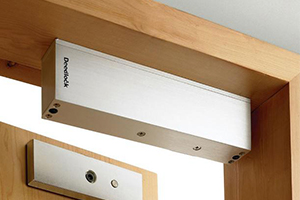
With the requirement for certificated products since the Grenfell Tower disaster, Securefast based in Cannock, Staffordshire, have seen an increase in sales for their electro-magnetic locks, with many clients, contractors and door manufacturers requesting the correct fire test and performance test evidence. Securefast are well known for their Deedlock range of electro-magnetic locks which includes surface mounted face to face, morticed, transom housing and gate versions. Many of their customers are using the electro-magnetic locks on escape and security doors following the introduction of their higher holding force electro-magnetic locks. With building regulation documents and technical documents for different countries varying slightly there has been a confusion as to what is acceptable or not. With the introduction of the standard EN13637, this allows the use of electrical panic hardware systems to be used on escape doors with the inclusion of Electro-magnetic Locks, Electric Locks, Electrical Panic Hardware, and Electric Releases. The standard allows the use of time delays which can be useful when used in residential homes to stop vulnerable residents from walk out in the middle of the night or in nurseries to prevent a young person from opening the escape door and wandering into the streets. However, it is important that building control approve any product which can inhibit safe egress from a building, regardless of the jurisdiction. The idea of the EN13637 standard was to: – (1) Improve security, (2) increase locking forces to the door using high holding force electro-magnetic locks / electric locks, (3) the option to link with the burglar alarm and (4) allow delay egress – allowing a member of staff to investigate before the door is opened. The benefit of using face to face or mortice electro-magnetic locks on escape doors is that the products have no mechanical parts which can fail or be damaged from misuse. Once the power is cut by either the operator at the door or fire alarm, the door releases instantly. One of the great benefits of using these electro-magnetic locks on escape doors is that the direction of release is in line with the direction of travel and will therefore not be affected by side load forces unlike electric or mechanical lock cases, which incorporate moving parts. In Scotland they have recognised this as a potential safety issue and therefore permit electro-magnetic locks on the escape doors. The Technical Document states that Fail-Unlocked Electric Lock cases should not be installed on any door which provides the only route of escape from the building or part of the building and if the building occupancy is more than 60 people. It is therefore important to check on the local or country regulations to ensure your specification complies. Many countries have yet to improve their building Regs documentation to include electrical hardware on escape doors, which includes Eire who work to the Technical Guidance Document B. However, installers are also referring to PAS 55 which is a PSA licensing requirement for locksmiths which again only makes reference to mechanical panic hardware, as their document was printed prior to EN13637 being introduced. Years ago, people were concerned about the magnetic residual holding or delaying the armature plate from releasing off the magnet, however this is no longer the case as the armature plates have a built-in button which is sprung loaded and pushes off the armature plate when the power is cut. It is important to note that shear electro-magnetic locks are not recommended for use on escape doors as the armature plate can be prevented from withdrawing fully from the door when side load pressure is applied, thus not conforming to any panic or emergency exit standards. With the introduction of TS010:2019 the Doors and Hardware Federation technical standard for electro-magnetic locks, Securefast was the first company to test to this standard which categorises the products into groups based on the holding force of the armature plate on the magnet and the type of electro-magnetic locks. Many suppliers of electro-magnetic locks quote holding forces which have not been tested to TS010:2019 and claim holding forces which are nowhere near what they state. The most important part of an electro-magnetic lock is its coil which should be 100% pure copper, the less copper or no copper at all means lower holding forces, so remember when you buy a low cost magnet it is probably because of the reduction in copper resulting in the reduction in holding force.. It is also interesting to note that when a Z&L bracket is fitted with any electro-magnetic lock for inward opening doors, the holding force is greatly reduced by up to 70% due to flexing of the bracket. To improve the holding force and aesthetics Securefast offer a transom housing which can be fitted along the header frame of the door or down the side of the door frame. These transom housings spread the load and reduce the flexing of the product which in turn increases the holding force. For greater holding force and higher security on the face to face fixed electro-magnetic locks, Securefast introduced their AEM12100 and AEM12200 Electro-magnetic Locks which have a minimum holding force when tested of 5900N (1326 lbs/f) (600 kg/f) equal to Grade 4 of TS010:2019 and will easily pass a PAS24 test which requires a minimum holding force of 4200N. A number of door manufacturers are now using the new AEM12000 and AEM12000R Mortice electro-magnetic locks on communal entrance doors, these have been tested to grade 3 of the TS010 standard and have been successfully included within burglary resistance tests. Operations and Technical Director, Kevin O’Reilly explains “the reason Securefast have been successful in growing its market in electrical architectural hardware is their commitment to developing a product and using 3rd party test houses before we enter the market. This guarantees a consistency in quality standards and ensures we only offer the very best in products. Before you specify and electro-magnetic lock request full test certification for both the Fire and the Holding Force.
Apprentice support service launched by ECA
Apprentice secondment service launched by ECA the leading engineering services trade association, extends the ‘loan labour scheme’, allowing employers to loan out and hire apprentices on a temporary basis. The ability to loan out apprentices for businesses usually happens for two reasons. The lender has a temporary workload shortfall, or they have limits to the variety of work they can undertake. In both cases, it can be difficult for the lender’s apprentice to fulfil the apprenticeship curriculum in time. The borrowing business can fill the gap whilst allowing the apprentice to continue to work and learn. Ensuring clear learning objectives and early involvement of the training provider is crucial. ECA Director of Employment and Skills Andrew Eldred commented on the Apprentice support service: “In these challenging times, some engineering services businesses are facing periods of time when they may struggle to find work for all their apprentices. Other firms are still busy, and are ready and able to help. “Given the critical importance of apprentices to the future of the industry, our new apprentice support service will help ensure that temporary opportunities can be found to keep them learning and in employment.” Research from The Electrotechnical Skills Partnership in 2018/19 found that apprentices deliver a net return to their employer of up to £57,000 within four years of joining the business. ECA has also produced guidance and flowcharts for businesses on how to keep apprentices employed and travelling and working safely during the current climate, with more tools and support to follow in the near future. The apprentice support service forms part of ECA’s broader ‘loan labour scheme’, which gives businesses flexibility to bring in high-quality staff without resorting to agencies. To find out more about ECA’s apprentice secondment service, please click here. To read more about Apprenticeships, take a look at our Training section.
Aico becomes an EIC Champion
Over the last few years, Aico have partnered with the Electrical Industries Charity (EIC) with the aim of strengthening and supporting the electrical industry. Aico are proud to announce that they are now recognised as an Electrical Industries Charity (EIC) Champion. As an EIC Champion, Aico are helping to support the only charity which is specifically for people working within the electrical industry and their families. Aico will also have exclusive access to health presentations created by EIC, which explore the different topics which affect the electrical industry, such as mental health, brain injury, financial wellbeing, and self-identity issues. An Aico colleague will be nominated as the internal EIC Champion representative. They will have the opportunity to discuss these health topics with a qualified member of the charity welfare team before delivering presentations to their Aico colleagues. Aico and the EIC have recently joined forces to help educate and increase understanding of mental health awareness with virtual, online training. These sessions will be run by a qualified EIC trainer and aim to provide an understanding of what mental health is, knowledge on some common mental health issues and encourage challenging of the stigmas associated with mental health. This initiative will help educate in ways to look after your own mental health and to support someone who may be in distress. The EIC are an industry charity that for over 100 years, have recognised the importance of providing the right support and meeting the wellbeing needs of individuals to create better workplaces and industry communities. As a member of the electrical and energy sector, you are entitled to all the support the EIC have to offer. This assistance is facilitated by a free and confidential helpline manned 365 days a year by the EIC’s dedicated welfare team. They offer support on things like family or relationship problems, financial or legal worries, emotional or mental health problems, and ill health or disability. Commenting on Aico becoming an EIC Champion, Aico Managing Director Neal Hooper said “The Electrical Industries Charity is more important than ever, especially with mental health support during this crisis. Becoming an EIC Champion means we can help in every way we can, such as facilitating mental health awareness training” For information on the mental health awareness sessions and to sign up, please contact your Aico Regional Specification Manager | www.aico.co.uk/contact-us/ For further information on the EIC and the ways in which they can offer support, please visit www.electricalcharity.org/ Samaritans Phone: 116 123 (free 24-hour helpline) |Website: www.samaritans.org.uk Mind Phone: 0300 123 3393 (Monday to Friday, 9am to 6pm) | Website: www.mind.org.uk
Final 5MW goes live at UK’s largest council-owned battery storage site

Kiwi Power, a leading global energy technology company that is simplifying distributed energy, has commissioned the final 5MW of battery storage at South Somerset District Council’s (SSDC) ground-breaking site at Fideoak Mill in Taunton. The additional £2.5m investment brings the site’s total capacity to 30MW, the UK’s largest council-owned battery storage site. Kiwi Power’s proprietary hardware, Fruit, was installed on all 22 battery units so that the site can provide grid balancing services to National Grid. “Councils across the UK are seeking to make the most out of their sustainability and carbon emissions investments as they seek to meet increasingly stringent targets. Landmark projects such as Fideoak are vital for demonstrating how investments in battery storage and renewables are value adding and income generating” Thomas Jennings, Head of Optimisation said. “With rapidly changing market dynamics, SSDC will be relying on our co-optimisation team to ensure that the £12m asset always participates in the right market at the right time so that it delivers the maximum return possible for the investment” Jennings added. David Owen, Director of Opium Power said: “Our partnership with South Somerset District Council and Kiwi Power has worked extremely well. The 30MW Taunton Battery Energy Storage System is the first of several very exciting joint ventures with local authorities and private sector investors that Opium Power is progressing to deliver stability to a sustainably powered grid. “We currently have an additional 110MW in design and build on three new battery storage systems, and we intend to work with Kiwi Power on all of them. “The UK has already accepted that we must adapt our electricity generation system to be carbon zero compliant by the use of renewables, and indeed the Government has legislated for it. Grid scale battery storage is the essential required component to stabilise the inherently unstable and non-dispatchable energy generated by solar and wind.” In June, Kiwi Power commissioned the first 25MW of the project in just four days. The final phase of the project – a further 5MW in capacity – has now also been commissioned. In total, 67 Fruits are synchronised together so that the site can participate in any of the UK’s 15 flexibility markets. “We were able to commission the site in record time despite COVID-19 disruption” Alistair Lowe, Head of Hardware at Kiwi Power said. “Relying on our proprietary hardware and VPP platform, along with a simulator that we built to test the code, we have been able to automate much of the commissioning and perform it remotely instead.” The site is unusual in the fact that the site controller must be able to simultaneously shut off all batteries with immediate effect in response to a constraint signal from Western Power Distribution. To facilitate this, Kiwi Power developed a solution based on its proprietary technology that could interpret the incoming signal and simultaneous dispatch it to each of the 22 units on site. Complete synchronicity was key to ensuring proper management. By adapting the existing infrastructure, site completion continued without delay or additional cost to the client.
