



Recolight celebrates 300 Million recycling milestone by launching extended service offering

Recolight, the UK’s leading lighting WEEE compliance scheme has announced a major milestone having funded the recycling of 300 million fluorescent & LED lamps and luminaires since the WEEE regulations were implemented in 2007. This is enough waste to fill the Royal Albert Hall ten times. Driving up the lamp WEEE recycling rate Recolight is unique amongst UK WEEE compliance schemes for having the only dedicated open collection point network for consumer and business waste fluorescent and LED lamps. With 3000 collection points, the Recolight network contributes to the continuing increase in the UK’s lamp recycling rate – up from 39.5% in 2012 to 48.5% in 2017. Nigel Harvey, Chief Executive of Recolight said, “Our Members can be very proud that they have helped to achieve this 300 million milestone; it is they that have made it possible and it is a testament to their dedication to improve lighting recycling in the UK. Their role is helping the UK to meet the national recycling targets set out in the recast WEEE directive.” Having recycled more lamps, LEDs and luminaires in total than all other UK WEEE schemes combined, Recolight can claim, with some justification, to be the leading WEEE compliance scheme for lighting. Extending the Recolight recycling offering Recolight has extended their recycling service to collect more waste electricals covered by the WEEE regulations. As a non-profit orgainsation, Recolight can provide this at a competitive cost. Suzanne Castine, marketing manager at Recolight added, “It’s great to be in a position to offer this complete WEEE recycling service. Feedback from our collection partners told us they wanted more. The success of our lamp and luminaire service over the years has made this possible. “ Recolight is exhibiting at Recycling & Waste Management trade show at the NEC, Birmingham on 12 to 13 September. The Recolight team will be on stand 4M32 to show how the extended recycling services can help.
What Does a Building Control Inspector See?

Whatever the build – a new build, extension, or a structural change – you will need building regulations approval. In this article woodworking machinery experts Daltons Wadkin will quickly take you through what to expect, look at some of the different types of inspections, and offer some advice. Firstly, it’s important to note the difference between planning approval and building regulations. Planning approval relates to receiving permission from the local authority to build an extension or new dwelling. Building regulations approval is a separate process, to ensure that the proposal will be built in full compliance. Once you’ve sorted which kind of approval you need, and before any work can begin, you need to decide whether to make a full plans building regulation application, or submit a building notice. With a building notice, it is possible for you to carry out the work without prior approval, but you need to be aware that the responsibility of ensuring the work is in full compliance, is entirely with the builder. If you choose a full plans application, then from the start you will know that the plan has been checked and approved by the building inspector, and that they fully comply with all of the building regulations. It’s important to note that the number and nature of the site inspections will vary according to the type of works being undertaken. Who Is Inspecting? Again, this varies with each type of build, but in most cases, you can choose to use either a local authority inspector from your local council and run through Local Authority Building Control (LABC), or an inspector from a government-approved private building inspection company. This is often the case for new builds, as well as alterations, extensions and loft conversions. You must check that the inspector is approved and registered with the Construction Industry Council. When a full plans application is made, a building inspector will check plans for compliance and carry out site inspections when requested, to check work on-site at various stages. Please bear in mind that only an inspector from your local authority has powers of enforcement, and an approved inspector must hand the project over to the local authority if there are problems with the project that cannot be resolved informally. To avoid any delays due to things being incorrect, it makes sense to keep on the right side of the inspector. They are there to help and are usually very willing to offer advice. Before starting any work, it’s a good idea to compare the approved building regulation plans with the original planning drawings one last time. Why not? It’s a quick job and can potentially save you any embarrassing mistakes. If the plans deviate in any way from the planning approved drawing, this needs to be addressed before any work starts. What Does a Building Control Inspector See? Well in short, lots! All projects – however big or small – will still be assessed in terms of the critical elements that need to be inspected, and again, each situation and build are different. Let’s use a domestic extension to give an example of possible inspection checks. Commencement:The first inspection will allow you to meet and discuss your proposals and subsequent course of action with your building control surveyor. This is particularly important for building notice applications where no plans have been submitted for approval. Foundations: They will look to check ground conditions to ensure that the foundations are sufficient to carry the load of your construction. This is before any foundations concrete is poured. Oversite Materials: Another inspection will be made to ensure materials and insulation over the site are suitable. Damp-Proof Courses and Membranes: All damp-proof courses, damp proof membranes, and methane barriers are to be inspected prior to covering with brickwork or concrete. Drainage Alignment:All new drainage needs to be inspected for alignment prior to covering over. This is to ensure the right access and fall is provided. Drain Test: Wherever possible, the new drainage systems should have a water test carried out on them, to check for performance and water tightness. Pre-Plasterboard: Allows for the inspection of hidden work and is to be carried out prior to plaster-boarding. This will also include any structural steelwork and the roof construction. Prior to Occupation: If there is an intention to occupy the building prior to completion of the full works, then there needs to be an inspection before occupation. Completion:Notification is required when the works are completed to allow this inspection to be carried out. If everything is found to be satisfactory, a completion certificate will be issued. Ideally, this inspection is carried out before the builder leaves the site. They may also look for the following: They may need to see the floor and ceiling joists to ensure they are in accordance with the approved drawing. They will want to check the size, grade and centres of the joists, together with any strutting and restraint strapping. All of the roof timber/trusses may be checked for correct size and grade of timbers at the correct spacing. They will be interested in both thermal and sound insulation to make sure it is of the correct type and thickness. The structural integrity of the building is very important, but equally the fire safety and glazing regulations need to be precisely adhered to. The staircase must conform to several important rules. If there are problems they can be expensive to put right. The approved plans do not always illustrate compliance to every regulation and on-site mistakes can happen. So, as you can see, there are lots of things to consider, and lots to get right! The Required Notification and Timings The building regulations require that notice is given to the local authority of commencement and completion of the work, and depending on the circumstance, at certain other stages too: Commencement: At least two days before the work is commenced Completion: Not more than five days after the work is completed In respect of other stages, the notice
Powering the Military
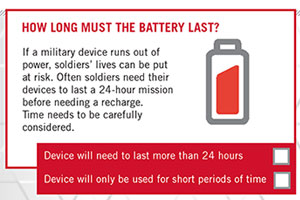
The power requirements of military equipment differ to those of many other devices. To guide design engineers when choosing a battery for their military device, global military battery specialist, Ultralife Corporation, has published a checklist highlighting the important considerations. The checklist, which can be downloaded from Ultralife’s website, consists of five key questions that design engineers must ask themselves before choosing a battery for a military device. The answer to each question will depend on the design of the device, how it will be used and in what conditions. “Unlike most battery-powered equipment, military devices are often exposed to incredibly harsh conditions such as extreme temperatures, rough physical handling and high moisture environments,” explained Johnathan Celso, applications engineer at Ultralife. “Design engineers must choose batteries capable of withstanding these conditions. To increase a battery’s robustness, they may also need to incorporate protective structures into the design.” However, robustness isn’t the only essential consideration. The battery must power the device in accordance with the needs of the soldier. For example, some devices are required to lie dormant for long periods, but rapidly activate when needed.” The failure of a device to meet a soldier’s requirements impedes the soldier’s ability to do their job and puts their lives at risk. The earlier that design engineers consider the battery, the better the device they provide to soldiers to meet their needs. As technology advances, the possibilities to provide soldiers with high quality, beneficial equipment are increasing. For example, many military devices now use smart batteries that communicate with the user regarding information such as the state-of-charge or the need to be cooled down. This checklist should prompt design engineers to make the high level considerations before embarking on new projects. Ultralife has a long history of manufacturing batteries and chargers for the military market. To find out more about portable power solutions for military use, contact a sales representative on +1 (315) 332 7100 or +44 (0) 1782 566 622.
Shielding and filtering are not independent of one another

I have lost count of the number of times I have been asked to fix an EMC problem, only to find that a shielding box has been designed or purchased to provide XdB up to fMAX. Or a filter has been designed or purchased with a similar specification, but to reduce cost the filter has been mounted on a printed circuit board (PCB) inside the box, with a cable from it entering or exiting the box through a plain connector. Of course, we want to reduce the bill of materials (BOM) cost – but at the expense of having to respin the design at least once and losing sales through delaying the time-to-market? I don’t think so! The cable entering or exiting the box through a plain connector is simply an “accidental radio frequency (RF) antenna” that couples unwanted EM noise between the inside and the outside of the shielded box. This has little to do with the signals or power that the cable is meant to be carrying but has everything to do with the fact that all conductors, whether electrical, mechanical or whatever, never mind their net names, never mind whether they have green insulation with a yellow stripe, always interact with their EM environments. When filters are tested by their manufacturers, they are first carefully installed in absolutely the best shielded enclosure that their manufacturers can afford, such as in the photograph below. Does this look like how the mains filter is installed in your new product? The upshot is that filtering and shielding have to be designed together, as a system. They simply cannot provide their shielding or filtering independently of each other. The sad and stupid thing is that no filter manufacturer ever provides any information on what shielding is necessary for their filters to function as specified. So, I guess it is understandable that designers who haven’t yet learnt the hard way – the very costly and time-consuming way – will assume that shield and filter specifications will be met by the shield and filters on their own. SPICE and similar circuit simulators assume that electric and magnetic fields don’t exist, so they incorrectly tell us that a filter will achieve whatever its specification says, or circuit design achieves. Such over-simplistic simulators completely ignore what will actually happen in real life unless appropriate shielding is integrated with the filter. I can only hope that some designers will read this brief blog, take the trouble to learn how to design shielding and filtering to work together to get the best out of both (takes a few hours, tops). I hope they never have to repeat the horribly costly and time-delaying learning curve that so very many designers have gone through before them. There’s simply no point! For more insight and information from Keith Armstrong and other experts in the field of EMC, visit the EMC Standards website on www.emcstandards.co.uk.
Demonstrating the Potential of the Offsite Technology in the North West

The first North West regional event in the Explore Offsite series will take place on 12 September 2018 in Manchester at the University of Salford. The combined conference and exhibition will bring together a range of offsite technology supply chain specialists and industry leaders to discuss the uptake of offsite construction within the region. Explore Offsite North West will focus on the key themes of offsite technology, supply chain resources and opportunities within the sector. Through informative case studies and presentations from industry pioneers, the event aims to attract construction clients, architects, engineers, specifiers, building product manufacturers and suppliers. Offsite manufacture is a progressive step that helps to challenge outdated assumptions about the construction sector and encourage more young professionals into the industry. The sector will generate savings in the long term, but the overwhelming message has been, that companies at every level of the supply chain should invest in offsite manufacture and construction processes sooner rather than later, or risk being left behind. A well-known figure in the North West – Tom Bloxham MBE, Chairman for Urban Splash, once sold fire extinguishers door to door. Following a meteoric rise to fame, Urban Splash has developed over a billion pounds of regeneration projects across the country. Tom was awarded an MBE for services to architecture and urban regeneration in 1999 at the age of 35. In his presentation ‘Urban Splash Modular and why we bought the Factory’ – Tom explains the rationale behind acquiring SIG’s modular factory and assets. “Urban Splash is committed to expanding its offsite construction capacity and this purchase is a way to vertically integrate our business and give us control of the production of our houses,” said Tom. “It is a testament to our commitment to, and investment in, modular housing.” Osco Homes is all about making a positive social impact, in her presentation Gwen Beeken, Managing Director – discusses how their successful affordable housing projects are employing a different workforce. A wholly owned subsidiary of Procure Plus, Osco Homes’ objective is to deliver affordable houses constructed offsite at a factory based in HM Prison Hindley, Greater Manchester. Within three years Osco Homes hope to reach an output of 1,000 homes a year. The model is for the prisoners to be trained and then supported into full time employment upon release. Of the 14 prisoners who are taking part in the scheme and have been recently released, nine gained full time employment and only one re-offended (7%) – the national average for re-offending within six months is a staggering 60%. This pioneering project uses fully offsite manufactured housing solutions – the aim of filling the skills gap in this way, makes it a truly innovative project. It is not just about building affordable homes but providing training and opportunities for people who may have taken a wrong turn in life but are keen to change. EOS Offsite Solutions design, manufacture and bring fully tested solutions to market which drives specification in UK construction. Peter Burchill from EOS Offsite Solutions will be presenting ‘Lightening the Load for the Residential Sector’. As experts in load bearing light steel frame (LSF) panelised and preassembled systems – EOS Offsite Solutions design and manufacture innovative load bearing pre-assembled solutions for pod and modular specialists, together with systems for multi-rise developments. With continued investment and expansion of production facilities, underpinned by 14 years’ experience in the offsite sector – EOS are geared up and ready to increase market share in the offsite load bearing market. EOS Offsite Solutions is part of Etex Building Performance which brings together the products and solutions of four dry construction materials companies – Siniat, Promat and EOS Facades. These speakers will be joined by experts and academics in the field of offsite technology and applications. Tickets cost just £125 plus vat and include; entry into the conference and exhibition, lunch and refreshments. For more information about the event, speakers and to book your place go to: www.exploreoffsite.co.uk/2018-events/explore-offsite-north-west
Instant Flex Appeal

Scruffs’ new innovation, the Trade Flex Trouser, equips trade professionals with the latest in workwear technology to deliver the ultimate wearer experience in terms of comfort, durability and performance. Designed for all year round use, the trouser is made from a hard wearing twill fabric with mechanical stretch to ensure freedom of movement. The slim fit shape provides a striking on-trend look. Abrasion-resistant Cordura® fabric knee pad pockets offer two positions for the knee pads for maximum comfort. Reinforced in key areas with triple stitched seams, the Trade Flex Trouser is suitable for a wide range of demanding applications across manual work environments. There’s a variety of pockets at different sizes that are made from a strong, reinforced polyester canvas to carry the vital tools needed to get the job done. Side positioned holster pockets ensure quick access while allowing the wearer to work without being obstructed. Whatever the challenge the impressive new Scruffs Trade Flex Trouser is designed to work as hard as you do. For more information about Scruffs, visit https://www.scruffs.com/ call 0115 938 9000, or email sales@birchwoodpricetools.com for more information on the range of products. ScruffsTrade Flex Trouser £34.96 ex VAT
The hills are alive with the sound of electricians as SELECT backs President’s Walk for Electrical Industries Charity

It was best foot forward on the rugged Pentland Hills as electricians’ body SELECT got behind the President’s Walk to raise much-needed funds for the industry’s own charity. Around 50 people took part in the challenging five and three-quarter mile hike from the Hillend Ski Slope over Caerketton and Allermuir Hills, enjoying views over Edinburgh and the attractive thatched cottages of Swanston village. All walkers made donations to the Electrical Industries Charity, which provides financial relief and practical support to people who have worked or are working in electrical-related industries. The day raised £500. Kevin Griffin, the SELECT President, said: “It was a great day out for everyone, with some of the loveliest scenery in Scotland and refreshments afterwards in the SELECT offices at the Walled Garden on the Bush Estate. “I would like to thank everyone who gave up their time to support the electrical industry’s own charity which does some marvellous work looking after people less fortunate than ourselves.” Marcella McArthur, Regional Business Development Manager for the Electrical Industries Charity, said: “We have been quite overwhelmed by the enthusiastic support for the President’s Walk which will raise very welcome funds for people in need.” The EIC helps all people working within the electrical, electronics and energy community, as well as their family members and retired colleagues, through the provision of four workplace programmes covering families, apprentices, pensioners and practical support. These programmes, which give the industry access to financial grants and a comprehensive range of free and confidential services, are provided free thanks to company donors, sponsors, volunteer committee members and fundraisers. SELECT’s 1250 member companies account for around 90% of all electrical installation work carried out in Scotland. They have a collective turnover of around £1 billion and provide employment for 15,000 people. W: www.select.org.uk Twitter: http://twitter.com/updates_select
Rogue trader jailed after investigation

A Lanarkshire man was sentenced to prison after falsely claiming to be NICEIC registered. The man from Belshill was ordered to spend 11 weeks in prison and fined £675 at Hamilton Sheriff Court recently. He pleaded guilty to running a fraudulent scheme by pretending he was an NICEIC Approved Contractor and authorised to issue NICEIC certificates and reports, which resulted in him obtaining money by fraudulent means. He also claimed he was a SELECT Approved Contractor and a Building Standards Approved Certifier. The action was taken by the North Lanarkshire Council Trading Standards team following a joint investigation with NICEIC. Michael McPake, of North Lanarkshire Council, commented, “I am delighted at the success of this case, which shows the continuing diligence of the council’s trading standards staff who pursue criminal enterprises, protecting consumers and the interests of legitimate trade. “We will continue to take a zero tolerance approach to individuals who rip off residents or businesses within our community.” NICEIC has urged anyone who is suspicious about using a registered electrician to check his or her details at the website www.niceic.com It contains a full list of all those contractors who are legitimately registered with NICEIC. “This latest prosecution shows how seriously we take misuse of our logo,” commented NICEIC CEO Emma Clancy. “It also sends out the message that anyone thinking about using our logo fraudulently will be caught and dealt with appropriately by the courts. “The NICEIC name is associated with quality and we will work with the appropriate authorities to protect those contractors who are legitimately registered with us and have the quality of their work assessed on a regular basis.” Contractors caught falsely claiming to be members will be named and shamed on the NICEIC website and their details passed to Trading Standards.
FAQ Blake UK and PROception Amplifier RED Compliance

What is RED? RED (Radio Equipment Directive – 2014/53/EU1) is a directive that applies across the EU including the UK and effects all manufacturers, distributors and installers of relevant product. The RED replaces the Radio and Telecommunications Terminal Equipment Directive but has extended its scope to include receivers including TV and Radio Broadcast What aspects of equipment does RED cover? The RED along with other directives which include the low Voltage Directive2 requires equipment to comply with a high level of electrical safety; with an adequate level of electromagnetic compatibility; and to operate in a manner that promotes efficient use of the radio spectrum. What equipment does it effect? RED applies to all equipment that intentionally transmits or receives radio waves. This includes ALL domestic TV signal amplifiers, which must as a minimum meet the requirements of EN 303 354 V1.1.1 (2017-03)3, “Amplifiers and active antennas for TV broadcast reception in domestic premises; Harmonised Standard covering the essential requirements of article 3.2 of Directive 2014/53/EU”. What shows me an amplifier is RED compliant? The product must have an EU Declaration of Conformity (DoC) and affix the CE marking. The DoC can either be in included in the product or referred to an online version. THERE IS NO OFFICIAL RED LOGO stating products are complaint other than the CE mark. What about other Logos used in the market. Do they show RED compliance? The LTE logo shown here is popular on products BUT DOES NOT indicate compliance to RED. Check for the DoC and separate manufacturers compliance. Liability and Enforcement of RED (Taken from an OFCOM Slide presented at the CAI Trade Show) These are legal requirements enforceable by Ofcom and Trading Standards. Manufacturers, importers, distributors (installers) are all responsible and are liable for any infringements. In a recent trading standards case it was stated “I cannot install it; the distributor cannot sell it and manufacturer can only sell it if they upgrade it to comply with the RED.” What are the performance tests specified in EN 303 354? Amplifier gain and flatness. Ensures that amplifier achieves the stated gain and is flat within ±2dB across the frequency response. Noise Figure. The degradation of signal-to-noise ratio (SNR) resulting from amplifier. Amplifier intermodulation. The ability of the amplifier to cope with numerous signals including LTE interference. Return Loss. The degree of mismatch that causes reflected signals at the amplifier’s inputs and outputs. Selectivity. The effectiveness of any inbuilt filter. The Radio Equipment Directive 2014/53/EU (RED) establishes a regulatory framework for placing radio equipment on the market. It ensures a Single Market for radio equipment by setting essential requirements for safety and health, electromagnetic compatibility, and the efficient use of the radio spectrum. It also provides the basis for further regulation governing some additional aspects. These include technical features for the protection of privacy, personal data and against fraud. Furthermore, additional aspects cover interoperability, access to emergency services, and compliance regarding the combination of radio equipment and software The Low Voltage Directive (LVD) (2014/35/EU) ensures that electrical equipment within the Single certain voltage limits provides a high level of protection for European citizens, and benefits fully from Market. It has been applicable since 20 April 2016. 3 https://www.etsi.org/deliver/etsi_en/303300_303399/303345/01.01.07_30/en_303345v010107v.pdf There are different classes in RED, what do they mean? The classes have been produced to fit the varying requirements of the TV transmitter changeover caused by the reallocation of broadcast spectrum to Mobile Phones Class 0 – Not filtered. This was decided upon in part due to the varying timescales for implementation of LTE across the EU, it allows suitable filters to be used for the local environment Class 1& 2 – For future use when LTE takes over the 700 MHz band and may also be below 470MHz Class 3 – 15dB inbuilt LTE filter but not for use in channel 60 areas. Class 4 – 15dB LTE filter allowing use of channel 60. Class 3 v Class 0. Class 3 products do not pass Ch 60 without severely degraded reception. There are still 121 transmitters using this frequency as of now. Locally to Sheffield Belmont services 710,00 homes and still uses channel 60. Whilst this is not long term after 2020 it still means that the consumer will lose channels they potentially had before a RED amplifier was installed. The specification for inbuilt filters on Ch 59 amplifiers is just 15 dB of LTE protection, but for the at800 standalone filter, supplied free if you have interference, it is 22–26 dB. There are filters on the market that have 40 dB of rejection. Considering that in some cases LTE signals can be 20 dB greater than TV signals, then in these cases the internal filter is not giving an adequate rejection and an external filter would also be required – more noise! It would be much better to fit a class 0 amplifier with an appropriate external filter in the first place. Class 0 amplifiers allow use of channels 61-68 for the distribution of locally modulated services such as CCTV, hotel ‘in house’ video and, in a domestic situation, for the distribution of signals such as Sky TV from the RF2 port of the Sky receiver (which are set at Ch 68 by default) or by using an add on IO link. Currently, the UHF band used for TV has only 40 channels. With up to 9 muxes per transmitter, and signals from adjacent transmitters being visible, it can be difficult to find a clear channel to carry locally modulated signals. Unlike classes 1-4, a class 0 amplifier gives access to the LTE bands (channels 61-68) for local signals, provided that adequate filtering is used to suppress any LTE signals that may be received. Facts and Figures for OUR Class 0 Products The internal immunity of our products is excellent, in some cases over 15dB higher than the pass mark! The noise level of the amplifiers is significantly lower than one with a filter, in tests some 2.5dB better! PROception
