



Sarah Hayes joins Hamilton as Northern Business Manager

Hamilton Litestat has further expanded its sales team with the appointment of Sarah Hayes as Northern Business Manager. With more than 25 years in the electricals industry, Sarah has worked both sides of the trade counter, making her well-versed in the needs of national and independent wholesalers. Her extensive experience comes from sales roles within major brands, including MK by Honeywell, Philips Lighting and Crompton Lamps. At Crompton Lamps, Hayes was responsible for both the UK sales team and the UK electrical wholesale customer base. “I am especially excited to be working for a family-run company with a team of experienced and loyal colleagues,” says Sarah. “My aim is to support the growth of the company and the sales team, and to continue developing the Hamilton brand through communication of its USPs of high-quality products, depth of range and its specialist support and service team. I’m also looking forward to working with all the latest technology and products, such as lighting control and multi-room audio control, communicating this offering to the wholesale client base within the north of England.” Sarah can be contacted at: sarah.hayes@hamilton-litestat.com www.hamilton-litestat.com
Port power

The journey from tree to power station can be treacherous for the humble wood pellet, but there is a lot riding on the successful delivery of this biomass fuel to power stations across the world. The cornerstone of the journey of these wood pellets are the ports that import this valuable cargo to be delivered to power stations across the UK. So, what would happen if these ports were to lose mains power supply? That’s exactly what happened to a port in the North of England, causing a shortage of biomass fuel for neighbouring power stations. From forest to fuel The delivery of fuel has one of the biggest effects on businesses and society. The journey begins in vast working forests in the US, where huge masses of wood pellets are loaded onto container ships for a transatlantic journey. When the ships pull into ports in the UK, these wood pellets are removed from the ship’s hold and transported onto conveyor belts, before being loaded onto a train. This process operates like clockwork. In fact, the four major biomass fuel ports in Britain process up to 12 million tonnes of biomass every year combined. From here, the trains carry large loads of pellets to the designated power stations across the country. Once at the final destination, conveyor belts carry these wood pellets from rail storage domes and into the furnace. The pellets are then combusted, which boils water to create steam that turns a generator, and hey presto, we have power. Investment opportunity Power stations rely on this seamless transportation process to operate, so it makes sense for a power station to invest in this delivery and distribution infrastructure. Several power stations have done just that, including a large 2017 civil engineering project, which saw a total of £300 million invested into the infrastructure of a well know port in the North-East of England. The relationship between port and power station is more important than ever before. Ports handle millions of tonnes of fuel, from coal to wood pellets every year. Therefore, if anything were to go wrong at the port, it would have huge knock-on implications for the power station later down the line. With ambitions for improved energy security, environmental sustainability and an increase in jobs, it could be argued that it is crucial that the infrastructure of ports, an essential part of the energy supply chain, is reinforced. Ironically, it is the power supply of ports in Britain that will be a huge factor in this investment. If the port is without power, the conveyors will be down, and power stations could be without fuel. So, what kind of investments and systems are being put in place to prevent this potential cause of downtime? Most facilities will have some sort of UPS system in place, a backup power system that uses charged up batteries. However, the duration of autonomous power supply will vary depending on the UPS product. As part of a larger infrastructure investment, CP Automation recently installed a Riello 3/1 phase UPS system at 40 kVa at one bustling UK port to improve the duration of its power supply. But first, the company needed to determine the correct UPS system for its site. Choosing the right UPS system Before implementing a new UPS system, the installer needs to determine whether the customer needs a single- or 3-phase UPS. This requires examining the loads the UPS will protect and assessing voltage range or kVa value. Generally, loads of 20kVA or less can safely use a single-phase UPS, whereas larger loads will likely need a 3-phase UPS. For port conveyor applications like this one, a 3-phase UPS is usually required. The next consideration is whether to use a 3/1 or 3/3 configuration. A 3/1 UPS takes in 3-phase power and outputs a single phase, while a 3/3 takes in 3-phase power and delivers 3-phase to the downstream loads. In 3 phase systems, the power circuit combines three alternating currents that vary in phase by 120 degrees. As a result, the power would never drop to zero, making it possible to carry more load, delivering more pellets to the power plant, more quickly. Most businesses choose a 3/3 phase UPS, but for an application used to keeping critical equipment in a port up and running, it could be argued that a longer UPS duration is needed. With this in mind, CP Automation installed a Riello 3/1 phase UPS system at 40 kVa to improve the ports power supply, complete with 80 rechargeable batteries. This provided the port with 1.5 hours of power autonomy during a power outage, much longer than it would have been if a 3/3 UPS alternative has been chosen. The batteries are charged by the rectifier; so that if mains power fails, the UPS uses this energy source to power the inverter. This means the associated power stations waiting on fuel supplies do not feel the effects of unplanned power outages at the port. CP Automation also installed active harmonic filters at the site to mitigate harmful harmonics at the facility. A total of six Comsys ADF P300 Active Filters were fitted to ensure the harmonics from all the variable speed drives (VSDs) on site were eliminated. With this type of investment, whether by the port itself, or the associated power stations, the power station should see a rapid return on investment (ROI) generated by decreased downtime and reduced delivery hold ups.
Online Sales of Non-Compliant Products – EucoLight Workshop brings together leading European Associations to highlight the scale of the problem

EucoLight, the European WEEE lighting trade association, is hosting a half day workshop on 17 Oct in Brussels to discuss the scale of the online non-compliance problem. Speakers from leading European Associations will share experiences, including WEEE freeriding, VAT non-payment, and non-compliance with safety standards. Policy makers and key stakeholders will debate challenges, visions and possible solutions to ensure a level playing field. As Marc Guiraud, Secretary General of EucoLight, points out: “The Digital economy is a success story. Nevertheless, a recent OECD report indicated though that non-compliance is a growing concern for products sold online. In our experience the lighting sector is particularly vulnerable to free riding as products are small, lightweight, and robust enough to be shipped easily. But, consequences from this problem are widespread and rules for product safety, environmental regulations, tax compliance and internal market regulations are affected. We have therefore invited representatives from various sectors and institutions to present.” Nigel Harvey, Recolight CEO and Vice President of EucoLight added “Recolight have drawn attention to the large scale online WEEE freeriding detected in the lighting sector. And although that is of profound significance to all legitimate operators in the WEEE industry, the problem is far wider. Consumers seem to be offered products that do not comply with safety or environmental standards, and on which VAT is not paid, on an unprecedented scale. I am delighted to be speaking at the workshop and look forward to hearing from legislators on actions being planned.” The agenda and registration details for the event can be found on the EucoLight website
Digitisation drives train stations for the better

Digitisation drives train stations for the better Shields Energy is on track to digitise the railway sector with its IoT solution, CODA, providing accurate data benefits and significant cost savings to over 200 UK railway stations. CODA streamlines processes, improves efficiency and supports predictive maintenance while also boosting energy efficiency and cost savings. Tangible benefits approaching half a million pounds have already been recouped by Shields’ CODA IoT solution for one train operator alone. Dan Shields, CEO of Shields Energy, said: “Digitisation of the rail sector is using data to drive informed business decision making with accurate IoT technology. “CODA’s ability to connect with a multitude of devices from within our clients’ estate provides full visibility and digitisation of railway station operations. These data driven insights and analytics, improve all aspects of a train stations operations. CODA then delivers substantial, and speedy, tangible business benefits from energy to financial savings, maintenance and operational performance to precise billing of multiple tenants within the station. “The ability to maximise the operational efficiency, deliver energy, carbon and operational savings, improve process performance and environmental conditions, increase asset life and reduce maintenance costs is all achieved through the continuous monitoring, controls and reactive / proactive maintenance works that we deliver.”
UK Construction Firms Offered ‘Brexit Insurance’

Worried construction sector bosses are being offered bespoke advice by specialists in Britain’s first ever Brexit Insurance consultations. Insurance experts ConstructionInsure.co.uk are offering free one on one advice sessions for builders and contractors concerned about the impact Brexit will have on the UK construction sector and their own businesses. The consultations have been introduced to ease the growing concerns of construction firms who fear a hard Brexit could have massive impact on their own companies and on the number of projects available after Britain leaves the European Union. There are estimated to be more than 120,000 EU migrants working in the UK construction sector, many in skilled positions. Experts have warned that the building industry is bracing itself for a possible shockwave if European workers choose to leave the country post Brexit. It would significantly increase the cost burden on UK building firms if they had to recruit and train UK staff to replace these EU nationals if they were to leave Britain in large numbers. Firms are also facing uncertainty over wage roll structure due to the changing status of who they employ and they need to make sure their insurances are up to date and correct. Now Construction Insure are holding the free Brexit Insurance consultations at their north London HQ to advise firms how best to protect themselves from the uncertainty around Brexit. Mark Herbert of ConstructionInsure.co.uk said firms were worried about both increased labour costs post Brexit and a possible downturn in business if the UK exits the EU without a strong trade deal. He said: “Depending on the outcome Brexit could have a huge impact on foreign workers working for UK based construction firms. “The main worry for UK construction firms is that instead of using foreign workers they will start having to increase their costs by training up UK workers. They are also likely to have an increased wage burden as they are forced to use higher skilled UK contractors to plug the gap. “We understand this is a major worry for thousands of UK construction firms and as the Brexit negotiations have dragged on without much apparent progress we have witnessed a steady increase in enquiries from builders and contractors eager to ensure they are adequately insured for any downturn in their business once Britain leaves the European Union. “For many this is the most pressing concern their business is currently facing and sadly it is totally out of their control. Many firms in the sector, particularly in London and the south east, but also in cities across the UK, rely heavily on EU migrants and there is a real worry about what might happen, particularly if we exit the EU without a strong trade deal. “Luckily there are steps companies can take to minimise any such impact if it were to happen. Construction Insure can look at their wages and turnover and let them know if they are insured correctly in the first place and we can also look to forecast what possible change these impacts form Brexit might have on their insurance premiums. “Many contractors do not understand the different type of labourers they use when trying to identify who relates to what on payroll breakdown for insurance purposes. This is crucial information which dictates premium and if gotten wrong can void policies or create huge additional premiums. “It’s an even bigger risk when trying to purchase a policy online where the client may be tempted to bypass certain questions just to get a cheaper premium. This is an easy trap to fall into but can have dire consequences. “Construction insure speaks to each client and defines to them what is a manual, labour only and a sub-contractor wage roll and ensures the clients policy has been rated correctly.” Research by the Construction Industry Training Board, IFF Research and the Institute of Employment Research at Warwick University found one third of companies in the construction industry currently employ foreign workers. The researchers said there were 122,094 construction workers working in Britain but born in other EU states, in 2015. These represented 45% of UK construction’s total 270,653 migrant workers. Any firms wishing to book onto a free Brexit Insurance consultation should ConstructionInsure.co.uk or call 020 3958 6868.
Dickies Launches Search For ‘Real’ Models

Global workwear brand Dickies has launched a search for ‘real’ tradespeople to model its clothing and footwear, in a break from traditional workwear advertising. Photography will be shot on site at their place of work – or within a typical working environment – and images will be used in print advertising, brochures and flyers, plus in social media activity. Content will be focused on their passion for their jobs and how their workwear supports them on a daily basis. “Dickies is designed and made for real tradespeople, so it makes sense to use those who rely on our workwear to model our ranges,” said James Whitaker, Marketing Director for Dickies. “We are striving for our advertising to be authentic. We don’t mind if our ‘real’ models have pot bellies, tattoos, yesterday’s stubble and there is no age limit! We hope that showcasing our workwear on other tradespeople will resonate well with our customers.” Those who wish to put themselves forward for consideration are invited to apply via email to: dickies_models@vfc.com, using the subject line ‘Make me a Dickies model’. Applicants should include a photo, plus their name, age, location, measurements and their trade. The Dickies marketing team will select a range of tradespeople of different ages from across the country. Dickies will visit and photograph/film each model in their place of work. The campaign will run throughout 2018 and beyond. www.dickiesworkwear.com
Refurbishing electrical systems – Boulting’s infographic sheds light on electrical refurbs
Award winning engineering solutions provider, Boulting, has released an infographic detailing ten top tips for engineers who are carrying out electrical refurbishments. The infographic highlights the most important aspects of the refurbishment process and educates plant managers about the importance of each stage. The infographic is free to download from the Boulting website. Every piece of electrical equipment within a plant will require regular maintenance and refurbishment. As a result, there is no one size fits all process for refurbishment as all plants and the equipment inside them are different. The areas for consideration, however remain the same. Boulting understands that, regardless of a project’s scale, a tried and tested refurbishment protocol is essential toensure successful completion of a project and that the site remains safe at all times. Its new infographic allows engineers to share in its wealth of knowledge and experience, by providing ten key areas to consider before beginning an electrical refurbishment. Topics in the infographic include, surveys, impactof downtime and the importance of having a contingency plan. “Electrical refurbishments are an integral part of our business and we are proud of our reputation of executing these complicated jobs to an extremely high standard” explained Paul Meagh, electrical and instrumentation director at Boulting. “The maintenance of electrical equipment is often easily overlooked, but it is essential for the equipment to be running as efficiently as possible, both to ensure running costs are minimised, but also to extend the life of existing assets. “Asset life extension is a popular concept for plant engineers, who wish to have long intervals between replacingequipment. As their current equipment has already been purchased, commissioned and is often working without fault, our aim is to keep the equipment in use for as long as realistically possible. Regular maintenance and effective refurbishment is a crucial aspect of this.” continued Meagh. For more information on Boulting’s services and products, visit www.boulting.co.uk.
SELECT unveils nominees for 2018 awards

Innovative and competitive electrical companies from across Scotland have been revealed to be in the running for coveted prizes in the Scottish electrotechnical industry’s most prestigious awards ceremony. Chosen by a panel of industry experts, the 2018 hopefuls have been named as nominees for awards from SELECT, the electrotechnical campaigning trade body and Scotland’s largest trade association. Entries for the awards came from electrical businesses from all parts of Scotland who operate both within their local communities and in the wider country, offering first-class service carried out by reputable, qualified electricians. This year’s awards ceremony, which is expected to be one of the best-attended ever, will be held in the Radisson Blue hotel in Glasgow on Friday, October 12, and will be hosted by radio and television personality Shereen Nanjiani. The awards come at a time when the electrical trade is moving ever closer to recognition as a profession as a consequence of a strong public safety campaign run by SELECT and currently being considered in the Scottish Parliament. A new category, Best Medium Contractor, is also being introduced to reflect the importance of diversity of range and capability within the sector. It will join major categories such as Apprentice of the Year and the Lifetime Achievement award. Darrell Matthews, who took over as Managing Director of SELECT earlier this year, said: “Once again we have a great line-up of the brightest and best individuals and companies in this high-tech sector. “SELECT is delighted to be the force behind this major awards event which recognises and rewards the resilience, professionalism and technical excellence of the people working in a challenging, science-based industry.” Mr Matthews also paid tribute to the generous support offered to the electrical sector by this year’s sponsors, who include new sponsors Whitecroft Lighting and Connect Communications, plus returning sponsors, The SJIB, Edmundson Electrical, Scolmore Group, City Electrical Factors, The Electrical Distributors’ Association, EC Insurance, Schneider Electric, Megger, Electrical Safety First and Ross Electrical. This year’s nominees are: Best Delivery of Customer Service * ATD Electrical Contractors (Newton Stewart) * Ideal Electrical Solutions (UK) Ltd (Edinburgh) * Invincible Security (Ardrossan) * L&M Electrical Contractors (Pitlochry) Best Use of Training * Stensons (Laurencekirk) Ltd (Laurencekirk) * Kenneth Ferguson Electrical Contractor (Oban) * Fife Council (Glenrothes) * Lotus Electrical Services (Dumfries) Best Electrical Safety Project * ATD Electrical Contractors (Newton Stewart) * Select Electrical & Mechanical Services Ltd (Annan) Best Small Contractor * JK Electrical (Glasgow) * L&M Electrical Contractors (Pitlochry) * ATD Electrical Contractors (Newton Stewart) * Select Electrical & Mechanical Services Ltd (Annan) Best Medium Contractor * Kenneth Ferguson Electrical Contractor (Oban) * K F Watson (Aberdeen) * Ideal Electrical Solutions (UK) Ltd (Edinburgh) * Moray Robertson Electrical Services (Stirling) Best Large Contractor * Mpact (Edinburgh) * Servest Arthur McKay (Bonnyrigg) * Maclin Electric (Musselburgh) * Lotus Electrical Services (Dumfries) Best Visual Promotion * Select Electrical & Mechanical Services Ltd (Annan) * Servest Arthur McKay (Bonnyrigg) * Ideal Electrical Solutions (UK) Ltd (Edinburgh) * Moray Robertson Electrical Services (Stirling) The Apprentice of the Year and a special Lifetime Achievement award for services to the trade will also be made at the ceremony. For more information please contact Alan Wilson, Head of Membership and Communications at SELECT, the Electrical Contractors’ Association of Scotland, The Walled Garden, Bush Estate, Midlothian, EH26 0SB. T: 0131 445 5577. E:admin@select.org.uk W:www.select.org.uk Twitter:http://twitter.com/updates_select
Snickers Comfort Fabrics For Maximum Mobility In New Stretch Clothing
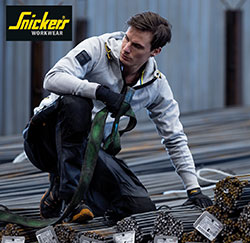
Snickers Workwear is well known for its uncompromising approach to quality and functionality, comfort and durability. Hi-tech fabrics and body-mapping designs ensure maximum working mobility wherever you are. With a range of new Trousers, Jackets, Rainwear and Accessories on their way, there’s plenty of scope for every professional craftsman and woman to stretch their performance on site comfortably. The brand new comfort fabrics woven into Snickers’ latest designs deliver enhanced freedom of movement as well as improved ventilation and close quarter mobility. They also mean that the clothes have a slimmer tailored fit for better all-round looks and protection against snagging. So check out these newest designs – the optimal choice for craftsmen and women who need to get the job done comfortably on site. Getting information on the Snickers’ new Comfort garments is easy. You can call the Snickers Helpline on 01484 854788, checkout the website and download a digital catalogue at www.snickersworkwear.co.uk or email info@snickersworkwear.co.uk
