



Are You Prepared For The Winter Rain and Wind?

Snickers NEW Waterproof Jackets will keep you warm and dry – all day, every day! You can count on year-round comfort and protection with Snickers Workwear NEW AllRoundWork Waterproof Jackets. They’ll make your working day easier and more comfortable with built-in quality, functionality and high performance features to cope with the very worst that the weather can throw at you. With lightweight and heavier-duty designs and styles for professional tradesmen and women, these jackets are 100% waterproof. The insides are fully sealed from the worst of the weather and every seam is taped or sealed. Even the pockets and cuffs are specially designed to keep the weather out and dry warmth in. There’s a host of designs, styles and extensive size options so you can select just the right jacket for you and your job. To back them up, Snickers has a great range of Winter Vests and Bodywarmers, even a Body Mapping Micro Fleece – so you’ll be well looked after all day, every day. Getting information on Snickers Worweark Jackets is easy. You can call the Snickers Helpline on 01484 854788, checkout the website and download a digital catalogue at www.snickersworkwear.co.uk or email info@snickersworkwear.co.uk
Electricians’ campaign top of the agenda at Scottish Parliament debate

The long-running campaign by SELECT, the electrotechnical trade association, which is also backed by the Scottish Joint Industry Board (The SJIB) and Unite the Union, for recognition of Electricians as a Profession achieved a major milestone last week (Oct 25) when the issue was debated in the Scottish Parliament. In a wide-ranging discussion, MSPs from all parties debated the call for the privilege of calling a person an electrician to be limited only to those who are qualified in this highly-skilled profession. The Holyrood debate was opened by Jamie Halcro Johnston, Scottish Conservative and Unionist MSP for the Highlands and Islands, who has backed the campaign in the interests of public safety from its early stages. During the debate, Mr Halcro Johnston told parliament that he had been staggered to learn that the people who entered our homes and businesses to install and maintain our wiring, fuse boxes and appliances need have no qualifications at all and yet they can still call themselves electricians. Responding to the debate, Jamie Hepburn, Minister for Business, Fair Work and Skills, thanked MSPs for their contributions and said that discussions would continue with the aim of bringing a ministerial view to parliament in due course. Alan Wilson, Acting Managing Director at SELECT, the Electrical Contractors’ Association of Scotland, thanked the MSPs who initially signed the Motion and who took part in the debate. He said: “Protection of Title has been at the forefront of our work for a number of years and in fact our recent campaign was triggered following a speech by a Government Minister at a European Electrical contractors conference held in Edinburgh in 2015. We are very grateful to have received support from Unite the union, the SJIB other trade bodies and politicians from all parties. “It is a major issue. The overall cost of poor and potentially dangerous electrical work in Scotland is around £120 million a year. “Recognition of the vital role that qualified electricians play in all parts of Scottish society is long overdue. These are highly-trained, uniquely qualified professional people whose contribution to modern life is immense.” Mr Halcro Johnston pointed out that, while more than 100 regulated professions exist in the UK – including gas engineers and even door supervisors at clubs – there is no protection afforded to electricians. His motion asked Parliament to recognise that improperly-installed electrical work creates a significant risk of fire as well as other harm to householders and that the installation of electrical work by unqualified or part qualified individuals carries a major safety risk. SELECT’s 1250 member companies account for around 90% of all electrical installation work carried out in Scotland. They have a collective turnover of around £1 billion and provide employment for 15,000 people. For more information please contact Alan Wilson, Acting Managing Director at SELECT, the Electrical Contractors’ Association of Scotland, The Walled Garden, Bush Estate, Midlothian, EH26 0SB. T: 0131 445 5577. F: 0131 445 5548. E: admin@select.org.uk. W: www.select.org.uk
Flexible trunking system for fast installation
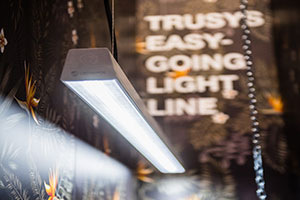
Consisting of mounting rails and flat linear lighting inserts, the new flexible trunking system TruSys offers homogeneous and energy-saving lighting for large areas. The lighting inserts can be easily clicked into place either as a continuous or intermittent lighting strip and mounted on the ceiling surface or suspended. The TruSys family of products from LEDVANCE can be installed in rows of up to 81 luminaries, achieving an overall length of 124metres, making them ideal for large industrial spaces. The exclusive “Scale” luminaire design is also used for the TruSys family with its high-quality and lightweight anodized aluminum housing. The mounting brackets are recessed in the rails and therefore almost invisible from the outside which adds to TruSys’ clean appearance, and internal holders keep the luminaire in place whilst being mounted. With a luminous efficacy of 135 lumen per watt, they are very energy-efficient. TruSys offers four different lenses: the wide-beam lens has a homogenous light distribution for uniform wide-area illumination in rooms with low ceilings – for example in workshops and factories. The narrow-beam lens offers the ideal lighting in areas with high ceilings, which is needed in high-bay warehouses. The double asymmetric lens version has bidirectional light distribution and is ideal for illuminating two shelves; and the wallwasher version offers single directional light distribution for highlighting single shelves or walls. The selection of the right lighting solution for each area within industrial applications helps to boost concentration, eliminate errors and improve efficiency. All versions of the TruSys family are available in warm white, cool white or daylight colour temperatures to help create the ideal working conditions. ABOUT LEDVANCE With offices in more than 50 countries and business activities in more than 140 countries, LEDVANCE is one of the world’s leading general lighting providers for professional users and end consumers. Having emerged from the general lighting business of OSRAM GmbH, LEDVANCE offers a wide-ranging assortment of LED luminaires for a broad spectrum of application areas, intelligent lighting products for Smart Homes and Buildings, one of the largest LED lamps portfolios in the industry, and traditional light sources. In fiscal year 2017, LEDVANCE achieved a turnover of around 1.9 billion Euro. Based on an agreement with OSRAM, LEDVANCE will continue to use the trusted OSRAM brand for many of its products (SYLVANIA for the USA and Canada). Further information can be found at www.ledvance.co.uk. Please contact LEDVANCE for more information on their lighting solutions: www.ledvance.co.uk
Contacta’s unique heat testing sees hearing loop driver ‘baked’ for 400 days – and counting

Assistive listening specialists, Contacta Systems, are conducting unprecedented testing of their V-series hearing loop driver to demonstrate the product’s quality. The V12a large area loop driver, launched in 2017, has been subject to temperatures of 60 degrees Celsius over 10 hours for more than 400 days, to test its heat dissipation and the longevity of its components. The newly designed V12a, along with the other drivers in Contacta’s V series range, features digital signal processers. As Contacta was first to the market with these, they wanted to be more than confident that prolonged stress of the driver wouldn’t affect its performance and reliability. “We sell many of these units into the United States where the distances an installer may have to travel could be hundreds or thousands of miles,” said Product Electronics Engineer, Andrew Page. “Producing a quality product is paramount for us but reliability is especially important when a maintenance visit could involve hours of driving.” The V12a starts the day at an ambient temperature of 15 degrees and switches on once the ‘oven’ it is in has reached its desired temperature. The driver runs for 10 hours continuously into 140 metres of cable loop and is only switched off at weekends as a fire safety measure. So far, the test has been running for 430 days and the driver’s performance is unchanged. “We’ve also been running the V12a with a sign wave which involves a greater power demand than an audio wave,” added Andrew, “so we are pleased to see the driver behaving just as it did on day one of the test. We’re not aware of any other driver that goes through such extensive heat testing.” The V12a is a constant current, dual output hearing loop driver with an integral phase shifter for phased array configuration. It has Class-D amplifier output stages and an audio sub-system built around an advanced DSP core. Combined with a powerful CPU to ensure peak performance, the V12a uses cutting edge technology to achieve life-like speech and first-class music reproduction. It also features a unique feedback mechanism which self-reports faults to installers via email. Like all V Series models, the V12a comes with an easy to use display-led set up process which makes installation far easier. All set up adjustments are done through the clear backlit display including power, HFC, RMS readings and more. Contacta aim to continue the heat test indefinitely to see just how long the driver will function perfectly for. “We want to gauge how many hours the V12a can perform in these conditions before component parts start to deteriorate,” said Andrew. “The results will then inform product development going forward to make sure we’re offering the very best standards we can.” www.contacta.co.uk
Jail sentence for online card manufacturer

A man who manufactured and sold fake construction industry skill cards, including ECS cards, has been jailed for more than three years. Online trader Andrew Weeks was sentenced on Friday 19th October at Warwick Crown Court. Mr Weeks was charged under Section 9 of the Fraud Act 2006; for the production and sale of fake documents. Mr Weeks was caught following an investigation by Warwickshire County Council Trading Standards. Over the course of the investigation officers discovered that Mr Weeks was manufacturing construction industry skill cards at his printing firm (Nuneaton Print) and selling them via his website. Mr Weeks was sentenced to 3 years and 8 months after pleading guilty to the manufacture of fake documents. The investigation was supported with information from the Construction Industry Training Board (CITB) and a number of card schemes including the Construction Skills Certification Scheme (CSCS) and the Electrotechnical Certification Scheme (ECS). To help individuals and employers verify ECS cardholder details, the ECS Check service is now available and ranges from the simple look up of an individual cardholder, to more comprehensive auditing and reporting systems for clients and contractors. Steve Brawley, Chief Executive at ECS said: “We hope that this case will serve as a message to would be fraudsters that their actions will not be accepted. Fraudsters on construction sites present a danger to themselves and others and we need to work together to stamp this activity out.” Graham Wren, Chief Executive at CSCS said: “This is another example of the industry working together to tackle card fraud. CSCS will always support the authorities to identify and act against those attempting to deceive construction employers. This case also highlights the need for thorough card checks, ideally electronically, to ensure construction workers are who they say they are and have the correct qualifications for the job they do on site.” Mr Weeks was also sued by CSCS for copyright infringement and ordered to pay damages of £6000. Ian Sidney, Fraud Manager at CITB said: “This sentence shows just how serious construction card fraud is and the lengths that CITB and the whole industry will go to in order to stamp it out. The use of fake cards could easily lead to accidents, injuries or even fatalities where contractors do not have the required skills, training or qualifications. Employers must remain vigilant when checking workers’ documentation and keep an eye out for any suspicious activity.” If you suspect a fraudulent ECS card you can verify the card details at www.ecscard.org.uk/check-card. If the card appears to be a forgery please contact ECS on 01322 661622 to report it.
Expect Better From Your Accessories? Change To Instinct.

For nearly 100 years Crabtree has been leading innovations in the wiring accessory industry. With the Instinct range, we are proud to say that we are keeping this forward-looking spirit alive. Instinct has all your needs covered, with over 300 new wiring accessories in the range. The range features slimline plates with soft curves, smooth lines and contoured profiles. These carefully considered design details ensure they fit naturally into any environment with a classically timeless look that will serve gracefully. While the operation of every switch gives a satisfying feel of quality and class – the kind of finishing touch that leaves clients happy and impressed with their contractor. So, if you expect better, Instinct is the way to go. A choice that represents ambition, development and progress. Take a look at some of the innovations and products detailed below and judge for yourself. Full contact cable clamps Instinct is the first range of wiring accessories to use this proven technology. These ‘No Miss’ terminals offer a more secure, more efficient, method of connection. There is no chance of incorrect cable positioning and this terminal design eradicates the risk of cable core damage that occurs with screw terminals. Upward facing terminals We have created upward facing terminals throughout the range, all accessible from one orientation, all with an instantly recognisable terminal layout including segregated inline supply and load terminals, nested for convenience. This improves installation time. It’s quicker and easier to connect. Cables can be cut to the same length and use less of the interior space. It gives safer and more reliable installation – no twisting or turning of the plate means no loosening of cables that were just terminated. Fused Connection Units and Switches Our Fused Connection Units and 20A switches have an improved, unobtrusive, integrated LED switch indicator and feature full contact clamps, help to improve cable positioning and retention. Angled Keystone Modules Improved Keystone Modules are safer and sleeker, offering flexibility and cable security, with less bend to cables. The variety of modules caters for Data, HDMI, USB, TV, Phone and Satellite applications. Integrated USB Sockets 13A sockets with double pole switching and Integrated USB charging outlets that meet the latest product standard (BS1363-2:2016+A1) and include automatic charge optimisation to match the corresponding device. Find out more at www.crabtreecommercial.co.uk Make a choice for the better, change to Instinct.
Customer Sales Leap, thanks to the new Carl Kammerling Quantum Scheme
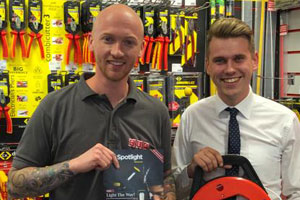
Carl Kammerling recently launched Quantum – an exciting new business development programme for customers. Based around 4 key elements, Quantum includes: 1. Innovative New Products – all developed by working closely with professional technicians; 2. Fantastic Range Deals – all block merchandised and backed by eye-catching POS; 3. Trade Price Promotion – to help retailers offer consumers incredible discounts of up to 60% on a great selection of core products. The fourth element of Quantum – aConsumer Promotion and Support Package,offers an array of effective marketing tools and merchandising solutions, designed to ensure products don’t just sit on the shelf. One customer in particular, who is really reaping the rewards of signing up to Quantum, is Luke Young, Assistant Manager at Electrical Wholesalers, CEF, in Stourbridge who, from selling hardly any tools at his branch, now cannot keep product on the shelf! Luke has also decided to add extra impact in store by taking on a 1m C.K backing board display, to allow products to be quickly identified and selected, which has been another important factor in driving impulse sales. Will Sheridan, Territory Sales Representative, for C.K tools commented: “Quantum has proved a real winner for CEF Stourbridge, by giving them the opportunity to extend their range with some exciting new products. This, in turn, has created lots of new interest and selling opportunities amongst their customers. Consequently, they are looking forward to using the Spotlight brochures, as another effective promotional selling tool in store.” www.carlkammerling.com
Designing for hazardous environments

When Mount Vesuvius erupted in AD79, the citizens of Pompeii were not prepared for the devastation that followed. Having lain dormant for the last 71 years, the Italian authorities continue to prepare for the next eruption from one of the most dangerous active volcanos in the world. Here, Paul Mannion, project engineer at engineering solutions provider Boulting, explains the considerations that should be made when designing for builds in hazardous environments. The Dangerous Substances and Explosive Atmosphere Regulations 2002 (DSEAR), defines a hazardous area as “any place in which an explosive atmosphere may occur in quantities such as to require special precautions to protect the safety of workers”. It is vital that precautions are taken when constructing, installing and using apparatus in areas that have been defined as hazardous. In the UK, the regulation BS EN 60079 part 10-1 and part 10-2 are used to determine the area classification, a method of analysing the environment where explosive gas and or dust atmospheres may occur. The DSEAR scope is extended with BS EN 60079 part 14 detailing the design, selection and erection of electrical installations within a hazardous area and BS EN ISO 80079-36 to incorporate non-electrical sources of ignition and mobile equipment that could also pose an ignition risk. Identifying hazardous environments Hazardous areas are classified under six zones. Three zones associated with gas are classified under Zone 0 and are areas where an explosive gas atmosphere is present continuously or for long periods of time. Zone 1 is an area where an explosive gas atmosphere is likely to occur in normal operation, while Zone 2 covers areas where an explosive gas atmosphere is not likely to occur in normal operation and if it occurs, will only exist for a short time. The other three zones are associated with dusts, which are either flying and explosive, conductive or non-conductive. It’s worth noting that 80 per cent of dusts are combustible. The associated three zones are Zone 20, an area where ignitable concentrations of combustible dust or ignitable fibers/flyings are present continuously or for long periods of time under normal operating conditions; Zone 21 an area where ignitable concentrations of combustible dust or ignitable fibers/flyings are likely to exist under normal operating conditions and; Zone 22, an area where ignitable concentrations of combustible dust or ignitable fibers/flyings are not likely to exist under normal operating conditions. Areas that do not fall under the six outlined categories are classified as non-hazardous or ‘safe areas’. Any facility that processes, uses or manufacture’s materials that may give rise to a flammable atmosphere, such as gas, mist, liquid and small fibres (dusts), may have a potentially explosive atmosphere and therefore fall into one of these six zones. Industries that may have an explosive atmosphere, include food manufacturing, power generation, water treatment, oil and gas, chemical manufacturing and pharmaceutical. Boulting’s qualified electrical engineers always visit a site before beginning work on a project to ensure the relevant protection systems are in place. By visiting the site beforehand and conducting the appropriate risk assessments, Boulting’s engineers can ensure that the build is specifically designed for that unique environment, taking into consideration any potential risks. As part of their role, Boulting ensures its engineers are aware of the latest legislation and safety requirements associated with the particular hazardous environment. While areas classified as Zone 0 or Zone 20 continuously face the potential for the creation of an explosive gas or dust atmosphere, work still needs to be conducted in these areas. To continue this work safely, the equipment used needs to be weighted so that there is no chance of creating explosions. Equipment should be designed in such a way that it is stringently safe and includes current limiting devices to stop sparks. The equipment that will be used should be chosen and tested as early in the design process as possible. Before equipment can be used in any hazardous area, it must undergo a programme of rigorous checks and testing by a registered ATEX test house. ATEX is the name given to two European directives that aid in controlling explosive atmospheres. The first, Directive 99/92/EC (ATEX 137) assess the minimum requirements for improving health and safety protection for workers in potentially explosive environments. Directive 94/9/EC (ATEX 95) looks at the laws concerning equipment and protective systems intended for use in potentially explosive environments. Constructability When constructing a new facility or working in an existing environment, it is important that the installation of new components is done using the most efficient techniques to reduce the risk of incidents. Modularisation is a technique often used by Boulting. This method sees equipment or parts of a facility built offsite and installed at a later date, taking the risk out of working on a hazardous site. In addition to constructing in a safer environment, modular builds reduce site disturbance, minimise waste, are more cost effective and allow for far greater design flexibility. Construction of the overall build can also take place much quicker as modular builds occur simultaneously to the main build. Boulting is a leading provider of mechanical and electrical prefabrication and modularisation services, which it completes at onsite workshops and fabrication sites such as its 9000m2facility in St. Helens. Techniques used include pre-assembled units, skids and building services modules. These processes allow us to standardise installation, helping to maintain high quality standards. Maintainability While ATEX testing is vital to identify and resolve potential risks at the start of a project, it is important that inspections continue to take place on a regular basis throughout the equipment’s lifespan. With the development of new software these inspections have started to incorporate risk based elements which are identified by HSE. This method of inspection looks at the type of protection used, the installation factors i.e. vibration, corrosive, outdoors etc in addition to common manufacturer/model failures Engineers should factor in the production of a schedule for periodic inspections at the design stage. At Boulting, we provide clients with a digital cloud based system where
Online marketplaces: a serious issue all over Europe

A workshop, hosted by Eucolight, the European association for lighting WEEE compliance schemes, gathered over 100 experts to discuss online sales of non-compliant products. The workshop concluded that solutions must be implemented to make online marketplaces responsible for products sold through their portals. The workshop, held in Brussels on 17 October, discussed the widespread availability of products through online marketplaces that do not comply with consumer safety standards, VAT requirements, and environmental obligations. High level speakers discussed who should be legally responsible for the non-conformity of products, and how this can be introduced into European and national legislation. The scale of the problem Leva Vardanyan, Market Compliance Manager of the Lighting Industry Association (LIA), reported on a retail mystery shopper testing study. The initial findings of the survey revealed that a high proportion of lighting products sold through online marketplaces have serious electrical safety risks. According to Ms Vardanyan, just removing the individual products detected from the market cannot be the solution, changes in the law and stronger tools for market surveillance are needed. Richard Allen, Lobbyist from Retailers Against VAT Abuse Schemes (RAVAS) described the large scale of VAT avoidance through online platforms. He argued that marketplaces have a great responsibility here. Through amendments to VAT legislation, the EU and and some Member States are supporting this approach and making marketplaces responsible. Germany, where there are new VAT obligations for online marketplaces if the seller is not compliant, is a good example. Nigel Harvey, Chief Executive of Recolight described a study undertaken by the WEEE Scheme Forum, to check the WEEE compliance of products sold through online marketplaces. This showed that 54% of power tools, 76% of LED lightbulbs, and 88% of fitness watches did not comply. Commenting on the study, Nigel Harvey said “Evidence shows there is large scale WEEE non-compliance sales through online marketplaces. High street retailers have, for many years, checked the compliance of equipment producers. Online marketplace operators could – and should – do the same. There can be no excuse for knowingly aiding the sale of products that break the law.” Monika Romenska, Regulatory & Public Affairs Manager,of EXPRA (Extended Producer Responsibility Alliance for Packaging and Packaging waste) added “Distance sales already represent up to 20 – 30 per cent of the market across various waste streams in certain Member States. By avoiding paying for their collection and reprocessing costs, these sales distort the market: they impose an unfair cost on compliant producers, thus rendering these – mostly local companies – less competitive.” The importance of greater consumer education was also mentioned. Triin Saag, of the European eCommerce & Omni-Channel Trade Association (EMOTA) argued, for example, that “product safety is a two way street where consumers should also be educated.” Views from the Commission Hans Ingels of DG Growth, speaking about the Goods Package, highlighted three principles for Member States to counteract an over-extended presence of non-compliant products on the market “1) working with businesses to prevent non-compliances instead of only policing the market; 2) fit-for purpose tools to check online sales of products and follow-up; and 3) improved cooperation between authorities across the EU.” Bettina Lorz, of DG Environment, supported coordinate enforcement actions at supra national/ national level. She argued that customs, tax and enforcement officials should work in a joined-up fashion with the environmental authorities on product regulation and enforcement: The Goods Package could be a good opportunity for implement this kind of synergy. Next steps – online marketplaces must take responsibility Summarizing the discussions, Marc Guiraud, Secretary General of EucoLight, stated ‘It is urgent for policy makers and online marketplaces to take action to address non-compliance of products sold online. Member States are already starting to implement this at a national level”.
