



Technological Considerations for Building a Successful Electrical eCommerce Strategy

George Brickwood, UK&I eCommerce Director at Schneider Electric Year on year, people are purchasing and selling more products and services online; between 2020 and 2025, the eCommerce market is expected to expand from 32.5% to 38.1% of total retail sales. While consumer sales account for a significant portion of the market, business-to-business (B2B) eCommerce is expanding. Fast. As digital technology gains a stronger hold on our lives, the global consumer marketplace influences enterprises, demonstrating the potential of eCommerce. Distributors must adapt to changing business needs and become more technologically aware in order to remain relevant in a competitive market. In this series, I’ll look at the aspects that contribute to a successful eCommerce strategy, with an emphasis on its applications in the electrical distribution industry. Each article will present one of three essential success criteria: technology, people, and processes. Electrical eCommerce: where are we now? The electrical distribution industry is a very traditional one and has been slower to adopt eCommerce compared to other industries. The key challenge is overcoming the level of investment required to develop an online presence and compete effectively. Another issue with the shift online is culture – for small traders in particular, word of mouth, personal contact and long-term relationships have been fundamental to success for generations. Shifting operations online can seem daunting and risky. However, threatened by an explosion in online competitors and in the wake of the COVID-19 pandemic, eCommerce is now critical to sustainable growth in electrical distribution. The current generation of B2B buyers are looking for ease and speed. To stay competitive, distributors must acknowledge the changing expectations of buyers and move away from the traditional, manual processes that hold the industry back. Ecommerce introduces increased flexibility and buying opportunity, which distributors must take advantage of. Put simply, to grow the customer base and keep existing customers loyal, distributors must find ways to add value to the buying experience. Transitional tech for eCommerce success To make the transition to online services, electrical distributors must make digital decisions that enable a streamlined online buying experience that attracts new buyers, and services existing customers. COVID-19 has further highlighted the need for eCommerce strategies to be robust, scalable and futureproof. Any eCommerce model must start with a platform that matches business needs. Mobile capability is critical as it is fast becoming the preferred purchase method for many B2B buyers. From a technical perspective, a mobile-first approach can provide greater flexibility as it is easier to scale and will render more easily across devices. With any online service dealing with customer data, security must be second to none; the repercussions from flaws or failures can be damaging both financially and reputationally. The strongest platforms provide an end-to-end secure connection across all data and transactions. What’s more, sales conversion is heavily influenced by a customer’s perception of website safety and data privacy. Remember, customer trust is as essential to the switch to an online distribution strategy as compliance and safeguarding. 2020 demonstrated the importance of flexibility and resilience. Cloud hosting has since pivoted from being useful to being indispensable. Cloud hosting helps to manage changing market demands by upscaling or downscaling services in line with traffic changes or seasonal peaks. Cloud services can also reduce costs as there is no upfront investment in infrastructure and prices fluctuate according to requirement and capacity. What’s more, cloud-based architecture can improve accessibility and reduce the chance of data loss or security threats. Integration in eCommerce delivers a streamlined experience and optimises data intelligence. Third-party integration connects front-end and back-end tools and systems, so that components can seamlessly interact with each other. By connecting separate platforms, insight can be derived from customer behaviour and actions, such as buying patterns and the results of marketing activity. When developing an eCommerce strategy, third-party integrations can offer new tools to expand customer experience and platform capabilities, to deliver a personalised journey. Finally, successful eCommerce in the electrical distribution industry requires analytic technology. Analytics help to understand what a customer wants from a buying experience by tracking their journey across the platform. For the electrical distributors, optimisation of customer experience is crucial for improving the shift from offline to online sales. With so many market competitors, the personalisation that analytics enables can elevate the experience to maintain customers and convert opportunities into sales. Choosing the right technology is critical for establishing a successful eCommerce strategy. The eCommerce needs in the electrical distribution industry, on the other hand, are diverse. It takes the proper people to create digital sales channels and give customer support and assistance, as well as the right processes to efficiently manage and scale changes. In the next part of the series, I’ll go through the people you’ll need to make your eCommerce adoption journey a success.
EnviroVent reveals sustainability roadmap to achieve net-zero carbon by 2030
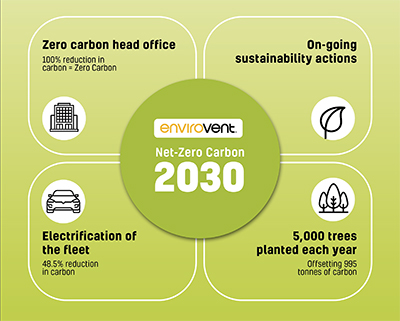
Harrogate-based ventilation manufacturer EnviroVent has revealed its Roadmap to Net Zero, which will see the company achieve net-zero carbon across its business by 2030. The company’s Roadmap to Net-Zero will generate emissions savings of over 1,000 tonnes of carbon in the next 10 years. Jane McLean, Quality & Environmental Systems Manager at EnviroVent, explains: “Environmental sustainability is very important to us as a business and to many of our public and private sector customers. We’re delighted to be revealing our Roadmap to Net-Zero, which gives a very clear route that we will follow to achieve our environmental targets. To add to this, all our products are designed to use minimal amount of energy and we recycle parts from systems we replace, wherever possible. As a result, customers buying our ventilation systems can be safe in the knowledge they are giving back to the planet.” To meet the ambitious target of Net-zero carbon by 2030, EnviroVent has put in place a number of sustainability practices to reduce the company’s carbon footprint. Recently this has included committing to planting 5,000 trees per year as part of a new partnership with MoreTrees, an organisation that will plant trees responsibly on the company’s behalf over a long-term period and then manage them for life. Planting 5,000 trees every year will remove a total of approximately 1,500 tonnes of CO2 from the atmosphere. EnviroVent’s Roadmap to Net-Zero also includes plans to relocate to a zero carbon purpose-built headquarters in 2022, which will be heated sustainably via air source heat pumps and its electricity will be generated via solar panels. The building will also incorporate a MVHR heat recovery system, which recovers the energy from extracted air to retain a comfortable environment for employees and ensure all year round good indoor air quality. In addition, the headquarters will feature optimum building design for insulation and will have electric charging points for vehicles to promote green travel by staff and visitors. The company has also focused on reducing emissions through its fleet as part of its Roadmap to net-zero via a combination of upgrading company vehicles and replacing diesel-fuelled cars with hybrid vehicles. For example, EnviroVent’s chosen plug-in hybrid vehicles will allow a major reduction in CO2 emissions and a 40 per cent reduction in fuel consumption compared to a petrol or diesel vehicle. EnviroVent is also involved in a number of projects that will help its social and private housing customers to reduce the carbon footprint and energy usage in their housing stock. Project 80 by the housing association Midland Heart is a new build scheme in Birmingham that will meet the Government’s Future Homes Standard, reducing carbon emissions by up to 80%. EnviroVent’s energiSava 250 MVHR (Mechanical Ventilation Heat Recovery) systems are being used within a number of the 12 homes being built here. Homes will be monitored constantly as this research and development programme will be used to inform the Government’s next consultation about the Future Homes Standard, which will be compulsory for all new homes built by 2025. Rebecca McLean, Marketing and Product Director at EnviroVent, said: “We are delighted to be involved in the Project 80 programme in providing the whole house MVHR systems to ensure good indoor air quality for residents. To be part of such a collaborative project to inform debate and input into this important consultation will be essential as we move forward to understand more about the Future Homes Standard.” EnviroVent’s sophisticated ventilation technology will also be incorporated within a pioneering new housing concept by Barratt Developments. Z House project is a flagship zero carbon home concept that will be built to substantially surpass the Future Homes Standard, delivering over 125% improvement. The new house will feature cutting edge technology including EnviroVent’s MEV 300 system. Powered by DC motor technology, the range uses the lowest energy consumption, reducing carbon emissions. For more details visit https://www.envirovent.com/project-z-house/ Rebecca McLean comments: “It is fantastic to be involved with this really innovative project which is shaping the way that the new homes of the future will be built, generating lower carbon and using renewable energy. A key element of this is to ensure better indoor air quality and it is exciting to see the part our products will play in this.” Being part of trade association BEAMA has seen EnviroVent further demonstrate its environmental commitments. EnviroVent has recently committed to BEAMA’s Net Zero Carbon pledge, which means it will be supporting the wider industry in delivering effective climate action. In addition, EnviroVent was recently commended for its commitment to the environment by winning The ASCP Safety & Compliance Awards for Best Product for Improvement to Wellbeing with its new ATMOS ventilation unit. ATMOS is a ventilation system which reduces condensation and eliminates mould growth in the home, whilst minimising energy usage and running costs. EnviroVent is one of the UK’s leading ventilation manufacturers. Located in Harrogate, the company supplies some of the top UK housebuilders, as well as local authorities, housing associations and homeowners. For more details of EnviroVent’s ventilation products, visit the website www.envirovent.com and to find out about its sustainability roadmap visit www.envirovent.com/about-us/sustainability or https://www.envirovent.com/roadmap-to-net-zero/
NAPIT welcomes long-awaited Government Strategies

NAPIT welcomes the Heat and Buildings Strategy and the Net Zero Strategy, published in October. The much anticipated documents set out a high-level overview of how the UK aims to reach the goal of net zero carbon emissions by 2050. The Heat and Buildings Strategy promises £3.9billion for the decarbonisation of heat within buildings to support innovation and incentivise uptake of low carbon heating systems. It sets out how the Government plans to phase out the use of gas boilers and restrict the installation of new gas boilers from 2035. It announces a 3-year Boiler Upgrade Scheme to support this. The new scheme offers grants of between £5,000-£6,000 to homeowners in England and Wales, to incentivise the installation of low carbon heating systems such as Air Source Heat Pumps, Ground Source Heat Pumps and Biomass Boilers. The upgrade scheme which is set to replace the Domestic Renewable Heat Incentive from Spring 2022, aims to encourage households to switch to low-carbon heating systems and it is hoped by Government that cleaner heat alternatives, such as heat pumps, will cost the same to buy and run as gas boilers by 2030. The boost in funding for the Social Housing Decarbonisation Fund and Home Upgrade Grant is also a welcome step towards decarbonisation, as is the Government’s pledge to develop a workforce pipeline with the skills to meet the requirements of the Net Zero transition. It is pleasing to read the Government’s commitment to work closely with industry to ensure installers have up-to-date, high-quality training and are not undercut by installers who offer low-quality, cheaper installations. Furthermore, it is encouraging to see that the Net Zero Strategy committing an additional £620million to support the transition to electric vehicles. This will support the rollout of the charging infrastructure with a particular focus on local on-street residential charging, and targeted plug-in vehicle grants. Commenting on the release of both strategy’s, NAPIT’s Group Chief Executive, Mike Andrews said: ‘We have been eagerly awaiting the publication of the Heat and Buildings Strategy and the Net Zero Strategy and welcome the direction that these two policies offer the industry. They set out the steps the Government intends to take to decarbonise the way we heat and power our buildings and provide a much needed level of certainty to the wider industry. As is often the case, the devil is in the detail, and whilst the strategies provide very useful oversight of future policy direction, we await further details about how the phasing out of fossil fuel boilers will be realised and what will be done to assist in the upskilling and re-skilling of installers which is needed to deliver the Government ambitions. Installers are set to play a key part in the transition to net-zero carbon emissions. They are the UK’s delivery network, and without a strong, stable, confident, and competent installer base, reducing the carbon emissions in buildings will not be possible. We will continue to support installers to meet the training and certification requirements needed to assist with the decarbonisation of our buildings, whilst continuing to provide feedback from industry on the delivery of these initiatives in order to support the Government in their policy design.’ To read the Heat and Buildings Strategy in full: click here To read the Zero Carbon Strategy in full: click here To see NAPIT’s infographic on the role of installers in meeting the Government’s Net Zero Targets: click here Tel: 0345 543 0330 www.napit.org.uk
HomeServe buys digital home emergency assistance business CET Structures Ltd

Acquisition will see the two companies serve almost five million UK Customers and share resources, technology and expertise Leading home repairs and improvements business HomeServe has continued its UK expansion with the acquisition of CET Structures Ltd (CET), a leading digital-first UK home emergency assistance business, for around £53million. The transaction, announced today, brings together the two complementary businesses which will serve a total of almost five million UK homes. While CET will continue to operate under its own brand with its own client and customer base, over time there will be significant opportunities to share technology and service expertise between the two businesses. Castle Donington-based CET provides emergency plumbing, heating, drainage, roofing, pest and electrics services to home insurance policy holders on behalf of a range of leading consumer brands, via its digital claims handling and job management platform. The acquisition of CET, which employees more than 300 staff in the UK, is a significant step forward in HomeServe’s strategy to develop its UK home assistance and heating installation capabilities John Kitzie, HomeServe UK Chief Executive, said: “We’re proud to bring CET into the HomeServe family, as the company shares a similar ethos to us, and it is also profitable and growing. “Together, we will serve almost five million UK Customers, and we believe there are some very exciting opportunities to share best practice, expertise, technology and resources, so we can continue to develop the plumbing, heating and electrics services that are core to both our organisations.” Richard Thomas, Senior Investment Director at Palatine, the previous owner of CET, commented: “The CET team have done an excellent job in growing the business through digitalisation, employee engagement and operational improvement. It’s been a pleasure partnering with the team and we wish them all the best on the next phase of their growth with HomeServe.” The purchase of CET continues HomeServe’s expansion in the domestic gas boiler service and support market. The company recently announced it had acquired Preston-based domestic heating business APG Domestic Services Ltd. You can follow HomeServe on Facebook and Twitter: @HomeServeUK And on Instagram: @HomeServe_UK Read its online lifestyle magazine: https://living.homeserve.com
COP26 is here, companies must get to grips with the fact that the key to going green successfully is to involve the workforce at every level

By Tim Dew The delegates to COP26 have bought their tickets and are leafing through their Glasgow guidebooks. More than 30,000 climate experts, campaigners, policymakers and world leaders have descended on the city for the most keenly-anticipated environmental event for years. As they gather to debate how to make progress on climate change, hundreds of thousands of people will attend side events in citizen meeting spaces to engage with each other on wide-ranging aspects of environmental awareness. The UK Government, as host, has acted by example with legally binding targets for greenhouse gas emission reduction and the Scottish Government has burnished its credentials with plans for net zero emissions by 2045. But fine words butter no parsnips, as the saying goes, and once all the talking is over and Glasgow settles back into its dark winter normality, it will be time to take a long, hard look at what is actually happening on the ground. In the factories, schools, offices, businesses and workplaces across the country, is the message getting through? Is there a recognition that time is of the essence if we want to create a sustainable future? Or will it just be back to business as usual? At first glance, the signs in Scotland are not particularly encouraging. Only a small minority – some 11% – of businesses are actually doing anything to address their carbon footprint. A slightly more heartening 50% believe that the issue is relevant. This, however, means that 50% of businesses do not believe that the crisis is upon us and nearly 90% are blithely carrying on as normal. Therefore, there is both a relevancy and an action problem. How can this be addressed? The key is to get the message across that, rather than being an additional burden, good sustainability and environmental and social governance practices lead to lower operating costs, better profitability and improved share price performance, according to research by Oxford University. There is also the matter of the attitudes of future customers. McKinsey research shows that for the increasingly important Gen Z demographic, consumption is a matter of ethical concern and that they will favour companies which best manage their environmental and social impact. As a localised example, Scottish companies are most likely to have to commit to net zero within nine months if they want to pick up public contracts. This is a huge indicator of where the market is going, and there really is only one direction of travel for us all. The good news is that companies do not have to transition to net zero overnight and relatively simple and easily implementable changes can take the organisation a long way down the carbon reduction road. And the key here is to get the workforce involved at every level of the business, leveraging and unleashing their latent talent and enthusiasms and bringing the decision-making about environmental impact into the body of the kirk. While it could be argued that the prevention agenda has largely been accepted at executive level, the real imperative now is to integrate the environmental message into entry and middle level training. We are making our own contribution to this new way of thinking with the launch during COP26 of our new sustainability training game: Go Green, which is designed to harness the power of experiential simulation learning to highlight the need for change throughout a company or organisation. This is not about telling people what to do, or lecturing them, but about engendering self-generated ideas which they can ‘own’ and implement, whatever their position in the hierarchy. It is about learning by doing, backed by the powerful influence of peer encouragement. The fact is that the overwhelming majority of people are already signed up to a green agenda in their personal lives, participating in recycling and other activities, so it is reasonable to argue that they would welcome the opportunity to put their principles into practice in their working lives. At the moment they may not have the agency or the permissions to implement the incremental changes which will rapidly become cumulative and make a significant positive difference. Bringing onboard everyone is key. It has been said before that the best way to get someone to believe in your idea is to get them to believe it was their idea in the first place, and raising awareness among staff will lead to practical suggestions from people who know how their part of the business works and how it could be improved. Business thinking used to be about people and profitability. Now we must add another P – People, Profitability and Planet. Tim Dew is Chief Executive of business simulation games company GingrTech. For more information, please contact Tim Dew, Chief Executive, GingrTech, Mount Parnassus, Edinburgh EH14 6AS. T: +44 131 210 0201. W: https://gingr.tech E: hello@gingr.tech Twitter: https://twitter.com/gingr_tech LinkedIn: https://www.linkedin.com/company/gingrtech/ Facebook: https://www.facebook.com/gingrtech
myenergi set to host EV drivers en route to COP26

myenergi welcomed electric vehicle drivers from across the UK and Europe to its eco headquarters in Lincolnshire, as they travel to the COP26 UN Climate Change Conference. Part of the ‘Electric Road to COP26’, an initiative organised by EVA England, EVA Scotland, GEVA and Local EV Groups (NEXUS), the group is visiting companies operating at the forefront of the electric vehicle revolution to raise awareness of the need for faster transport decarbonisation. When they arrive at myenergi, drivers will have the opportunity to meet the green team and take a private tour of the company’s state-of-the-art facility. They will also be introduced to myenergi’s latest range of renewable energy technologies, including the eco-smart zappi EV charger. From here, the group will travel up to the Britishvolt EV battery gigafactory site in Northumberland, before arriving in Glasgow for the opening of COP26. During the two-week event, representatives will be calling for all sales of new cars and light duty vans to have a plug by 2030 and be zero emission by 2035. Jordan Brompton, co-founder and CMO of myenergi, commented: “We’re looking forward to hosting drivers taking part in the Electric Road to COP26. As well as putting on lunch, we’ll be offering guided tours of our pioneering eco headquarters, which was officially opened earlier this year. “Initiatives to raise awareness of transport decarbonisation are hugely important. Indeed, transportation accounts for 24% of direct CO2 emissions from fuel combustion globally, of which road vehicles are responsible for nearly 75%. A rapid shift to electrification is essential to combat these statistics, but legislation is critical to accelerating the transition.” Alongside hosting the Electric Road to COP26 visit, members of the myenergi team will also be attending COP26. Kate Tyrrell, events & relationship manager, will be speaking at the COP26 Ferry Event (hosted by National Grid) and promoting eco-smart technologies in the Green Zone throughout the two-week event. For more information about the Electric Road to COP26, please visit www.evaengland.org.uk. For more information about myenergi, or the company’s eco-smart range of renewable energy technologies, visit www.myenergi.com.
One in twelve advertised jobs in the UK is in the Trade & Construction sector

345% more jobs are being advertised now than this time last year. New research1 from UK-wide trade supplies merchant City Plumbing reveals that there are over one million advertised jobs in the Trade & Construction sector in UK right now (1.17 million), representing 8% of all open roles. Furthermore, this has increased by 345% in the last year alone highlighting just how much this sector is booming. Builders/labourers are the most sought-after tradespeople currently (8,100 vacancies), followed by electricians (5,641), painter/decorators (3,866), carpenters (3,491) and plumbers (3,251). Tradespeople are most sought-after in Kent, Manchester, South East London & Hampshire The average advertised salary in this sector is £37,939 – 10.9% higher than the UK average 7% of all apprenticeships commenced this year were in the construction sector, but the number of apprentices has declined in recent years Experts are calling on more people to retrain as a plumber, builder etc to help meet the skills demand Further information on the rankings can be found at: https://www.cityplumbing.co.uk/blog/schools-out-trades-in Kent, Greater Manchester, South East London, Hampshire and Essex currently have the most trade roles being advertised. Top Ten UK Areas with the Most Trade/Construction Roles Advertised Area Number Roles Currently Advertised 1 Kent 3,957 2 Greater Manchester 3,345 3 South East London 3,202 4 Hampshire 2,889 5 Essex 2,803 6 Hertfordshire 2,543 7 Surrey 2,266 8 East Sussex 2,179 9 Buckinghamshire 2,025 10 West Yorkshire 2,008 The current advertised salary in this sector is £37,939 per year, which is 10.9% higher than the UK average (£34,261). Salaries here have also increased 4.3% year-on-year, with demand increasing competition and this in turn driving up the amount of money that businesses are prepared to pay for skilled tradespeople. Current average advertised salary per role: Heating Engineer £44,305 Carpenter £41,284 Window Fitter £40,198 Plumber/Pipe Fitter £38,573 Tiler £38,377 Electrician £37,780 Bathroom Fitter £37,158 Joiner £36,746 Plasterer £35,498 Painter Decorator £33,004 Floor Layer £32,403 Roofer £32,244 Tradesperson £30,294 Carpet Fitter £30,194 Tree Surgeon £28,883 Specialist Welder £27,436 Landscape Gardener £27,319 Builder/Labourer £23,450 Locksmith £25,830 Demand in some areas is further increasing salaries for specific roles too – a gardener in Manchester could earn £9k more than the UK average (£34,093 versus £25,047) and it’s the same for a plumber in Warrington (£41,889 versus £32,864). An apprenticeship is the usual route into this industry, and 7% of all apprenticeships that commenced in England this year were in the construction/planning and build environment sector. However, the number of trade apprentices has declined recently – there were 17,700 starters this year, down from 21,920 in 2020 and 22,530 in 2019. In a typical year, 85% of new apprentices are aged 25 or under, and experts believe that in order to plug the current skills gap more older adults should be encouraged to re-train in this area. City Plumbing’s ‘School’s Out, Trades In’ report reveals that more than one in nine working adults in the UK (12%) are currently considering it too. The most popular trades to upskill in are plumbing (11%), building (11%), gardening (8%), electrics (6%), joinery (6%) and painting/decorating (5%). Oli Street, 35 from Leeds in Yorkshire has been studying for a plumbing diploma and intends to take this on full-time when qualified, moving on from his current job in recruitment. He said: “Plumbing is something that I’ve done elements of previously and really enjoyed doing – I prefer a role that’s hands on and where I can see a project to completion, so it seemed a natural trade for me to pursue. It’s something I’ve given a lot of thought to over the years and I’m lucky that my current employer is supportive of my new direction in life. In the past couple of years, I’ve completed both my Level One and Two Plumbing Studies Diploma, and I’m currently awaiting the start of an Advanced Diploma Level Three. I’m very lucky that my Level Three has coincided with the National Skills Fund (NSF) which means the course is fully funded by the Government. Following this, my plan is to do my NVQ2, which is a vocational qualification, with the overall goal of starting my own company in the not-too-distant future. Andrew Hunter, co-founder of job search engine Adzuna, commented: “Demand for skilled tradespeople has gone through the roof since the start of the pandemic. Powered by a surge in demand for home improvements, the last year has seen a sharp increase in advertised job vacancies for trades ranging from plumbers, builders and plasterers, to heating engineers, bathroom fitters, and tree surgeons. Factoring in an existing shortage of skilled workers, plus the dip in overseas tradespeople bringing their skills to the UK due to the pandemic, and demand for skilled professionals is at an all-time high. For young people starting out and adults considering retraining in this sector, now is a great time to learn this craft with thousands of job openings on offer and advertised salaries pushing up as employers compete for skilled staff.” A spokesperson for City Plumbing added: “It’s clear from our research that there is a great deal of opportunity for both young adults considering a career in this sector, or anyone thinking about retraining in plumbing, building and so on. There certainly look to be some towns and cities across the UK where this is currently a skills shortage, and the CITB recently said that the industry will need more than 200,000 new workers by 2025 to meet demand. Here at City Plumbing, our specialist team always looks to offer both new professionals and experienced tradespeople professional advice to assist them with their next project. Our trade account holders also enjoy discounts on products and can use any of our 350 nationwide branches.” For more information please visit: https://www.cityplumbing.co.uk/blog/schools-out-trades-in
Schneider Electric Brings Net Zero Homes Closer with a Host of Revolutionary Innovations

Schneider Electric, the World’s Most Sustainable Company in 2021 as ranked by Corporate Knights and leader in digital transformation of energy management, is today unveiling a suite of cutting edge connected living products, making our homes both smart and sustainable. These smart home innovations are a game changer for sustainable living through improved energy saving and the use of renewable energy in the home, coupled with reduced use of virgin plastic and better circularity. YiFu Qi, Executive Vice President, Schneider Electric, said: “Today, homes represent 20% of global CO2 emissions worldwide. To get to our net zero goal, we must move 3-5 times faster to decarbonize, halving our carbon emissions by 2030. Therefore, getting consumers on side in the fight against climate change has never been more important. As more and more smart home devices are powered by smart and clean electricity – from heating to cooking to personal transportation – we have an opportunity to decarbonize our dwellings at pace without changing our digital and connected lifestyles. What’s more, we can help create genuine demand for recycled plastic and e-waste, from abandoned fishing nets to retired white goods and home appliances, driving a fully functioning circular economy. This is now possible through cutting-edge technology and innovation – positive change starts at home.” These are the three innovations Schneider Electric is making available across a variety of markets today: Energy efficient smart homes are the passport to a sustainable future Wiser Energy Center: this new smart panel seamlessly integrating solar panels, batteries, inverters and cutting-edge energy management. All electrical energy from the home and the grid converges in a single panel where load control is managed directly: from grid to plug with the help of extremely advanced Artificial Intelligence (AI). Where possible, the system prioritizes green energy power, ensuring power-hungry appliances and devices, such as Electric Vehicles (EVs), consume most of their energy from the solar or decarbonized energy sources in the home. The intelligent system achieves this by taking multiple factors into account, including time, the weather, the residents’ energy tariff and consumption patterns, storing large amounts of solar energy for emergency back-up power. This means critical safety and connectivity systems are maintained, should traditional energy sources become unavailable. As a result, the home becomes energy efficient, sustainable, resilient as well as more responsive to the needs of the residents. Lower energy bills, reduced energy loss and increased use of renewable energy benefit both the homeowner and the planet. The panel will be available in France in Q1 2022. Switches and panels made of recycled plastic drive circularity Elko+ switches: this range of switches is the first in the world to be made of recycled ocean plastic. Known for their timeless modern design, the range now includes a new model made from ocean material, more specifically, polyamide fishing nets. Developed and produced together with DSM, it marks the first step in making the products more sustainable and can be identified by the Ocean Plastic Logo engraved on the back. This new model contributes to reducing the 640,000 tons of fishing nets that are left in the ocean each year, while boasting 82% lower carbon footprint of the raw material used (Akulon repurposed) compared to traditional Nylon6. The products are also reinforced with 15% glass-fiber to make the product durable, long lasting, and more importantly, meet all electrical safety requirements. Available in Norway by Q4 2021. The Merten range: Schneider Electric will further expand the family of products made from recycled ocean plastic waste by launching switches made of Ocean plastic in the Merten family as well. These will be made available in Germany, Austria and select European countries by end of Q2 2022. Cradle to Cradle Certification – Silver: The Merten range of switches are the first in the industry to get a “Silver” level for Cradle-to-Cradle certifications. These switches and sockets are already one of the most prominent players in the German market and now they will also stand for high level of sustainability credibility with these certifications. The Cradle-to-cradle certification for Merten was upgraded to silver in July 2021 this year. Schneider Electric unveiled more smart and sustainable home innovations at the Paris Marathon on 17th October 2021. Schneider Electric’s Home of the Future exhibition, featuring the new Ocean Plastic range, how to make smart homes sustainable. See a full smart home installation with Schneider’s Wiser Energy Center at the core, connecting smart plugs, window sensors, heating, temperature and motion sensors EV charging and more in every room, all from the power of the Wiser App.
Emergency lighting: surface vs recessed
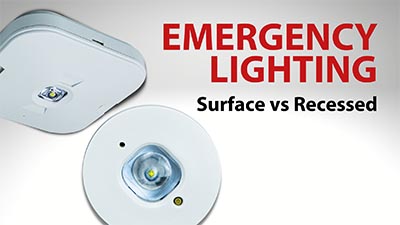
Thanks to LED and compact battery technology, surface mounted emergency lighting is now convenient, easy to install and unobtrusive. But is it being unnecessarily overlooked in favour of recessed, in situations where surface-mounted could be the better option? Here, Red Arrow Trading examines how surface mounted lighting has changed, and explore the advantages of latest-generation surface mounted emergency lighting products. The different types of emergency lighting BS EN 1838 specifies that emergency lighting is required to maintain illumination for a minimum of one to three hours in the event of a power outage, to enable people to safely evacuate a building. The exact time needed depends on the use and risk of the premises, the immediacy of evacuation and the time needed for re-occupation. For example, buildings where people sleep, such as hotels or residences, require battery backup duration of at least 3 hours. Emergency lighting can include a mix of illuminated signage, stand-alone fittings and incorporated lighting. The main emergency lighting requirements for commercial premises are: Escape Route Lighting, that guides occupants through exit routes. Open Area Emergency Lighting (also known as ‘anti-panic’ lighting) that maintains illumination in open areas, allowing people to calmly find their escape route. Stay put/Safety Lighting that allows occupants to stay in the building until there is one hour of illumination left, before being escorted to a safe place. High Risk Task Area lighting may also be required in certain industrial or mechanical environments but is covered by different requirements to the one discussed in this article (for more information on High Risk Task Area bulkheads please contact Red Arrow directly). Businesses can then choose whether to opt for maintained lighting or non-maintained lighting, self-contained or central battery sourced systems, and recessed or non-recessed models. Maintained lighting are constantly kept on, either as part of the ‘normal’ lighting system or permanently illuminated signage (such as Exit signs found in theatres and cinemas). These luminaires are mains powered when in everyday use but powered by a backup battery in the event of power failure. Maintained emergency lights can be differentiated from other ‘normal’ lights by a green indicator light. Switch Maintained lighting is used as part of the ‘normal’ lighting system but can be switched off when not in use (but will still function in an emergency). Non-maintained lighting only comes on when power supply to the everyday lighting system fails. These are powered by a battery that is charged by mains power and activates in the event of power failure to the fitting. Self-contained or ‘single point’ emergency lights each have their own battery source, while central battery source emergency lights connect several lights to one battery. Finally, recessed emergency lights sit flush to ceilings and walls, with the battery hidden behind them, while surface-mounted emergency lights affix to the surface – batteries included – with only a small hole needed to hardwire the fixture to the mains. Yet while surface-mounted fire alarms and carbon monoxide detectors are already accepted as a necessary safety product, surface-mounted emergency lighting is lagging behind, and is still seen as obtrusive (or just plain ugly). As a result, emergency lighting installers are tasked with the more disruptive, messy and time-consuming task of drilling large holes to house the light fitting and hide the battery – despite recent improvements to surface mounted models dramatically changing their visual impact, efficacy and reliability. LED technology Traditional emergency lighting luminaires, such as a fluorescent, suffered from battery compatibility issues which reduced their lifespans. As such, many emergency lights were only effective in an emergency for a limited number of times, before they needed to be replaced. LED eradicates these issues, requiring much less power to run, with much more compact lamps and drivers making them easier to incorporate into smaller fittings. Better batteries In the past, emergency lighting batteries were based around SLA (Sealed Lead Acid) technology, leading to much bulkier fittings and subsequently more requirement for the battery to be hidden away during installation. These were replaced by Nickel Cadmium batteries, a more compact alternative. Now, Lithium Iron Phosphate (LiFePO4) batteries are revolutionising the size and longevity of batteries: not only are they much smaller, but they are longer lasting in terms of recharge and discharge cycles. As a result, they can be incorporated into much smaller emergency lighting fittings and stand-alone products such as illuminated signage. Advantages of surface mounted These technological advantages have made all types of emergency lighting more discrete, reliable and energy efficient, but it’s surface-mounted emergency lighting that has really been transformed. Surface-mounted models are now slimline and compact, making them less noticeable once they are installed, as well as simple to install, replace and maintain. For instance, a surface mounted non-maintained emergency light is much quicker and easier to identify during fire safety inspections than the small green indicator light found on a maintained light. For awkward installations, such as listed buildings, architectural anomalies or jobs where time is of the essence and disruption needs to be minimal (such as care homes or schools), surface-mounted emergency lighting provides a low-impact, fast, and reliable option compared to fitting recessed models. It’s time for installers and commercial property managers to see how much has changed since the days of unreliable fluorescents and bulky battery packs, and recognise surface mounted emergency lights as the best option for a wide range of properties. Much like seatbelts or anti lock brakes, emergency lighting should be easy to forget it’sthey are there until you need it– but it’s crucial that it works as intended when you do. Discrete, slimline surface mounted emergency lights fulfil both functions, providing a safe and reliable but unobtrusive solution. About the Sentinel Red Arrow’s Sentinel range of LED emergency light fittings are available in both recessed or surface mounted options, for Escape Route or Open Area requirements. Slimline and compact, these standalone Emergency Lights are a more cost-effective and energy efficient alternative to maintained emergency lights. To find out more about the range,
